Competitive landscape · Partner briefing · August 2026
Everyone monitors a thesis. Nobody keeps the record.
Seven products already sell thesis tracking, evidence citations and decision
journals. None connects the whole chain — from the filing that changed your mind to the
outcome that proved you right or wrong. That chain is ClassicInvestor.
ProductClassicInvestor
Competitors assessed7 direct · 5 adjacent
Product screenshots38 across all 7
Capabilities compared16 across 8 journey stages
Domains verified6 of 7
Evidence basePublic product material, Aug 2026
ClassicInvestor · Competitive landscape
01 — The conclusion first
The market is not empty, and that is the most useful thing we know
Competitors already ship almost every feature that could superficially define
this product. Any pitch built on a single capability is already answered by someone with a
live product and paying users.
7Direct and near-direct competitors assessed
0 / 7Cover all eight journey stages
6 / 8Best coverage — subThesis
0 / 7Rated Full on general financial analysis
None of these is defensible on its own:
“AI monitors your thesis.” · “Chat with company filings.” ·
“Keep an investment journal.” · “Version-control your thesis.” ·
“Connect your brokerage account.” · “Get alerts when the thesis changes.”
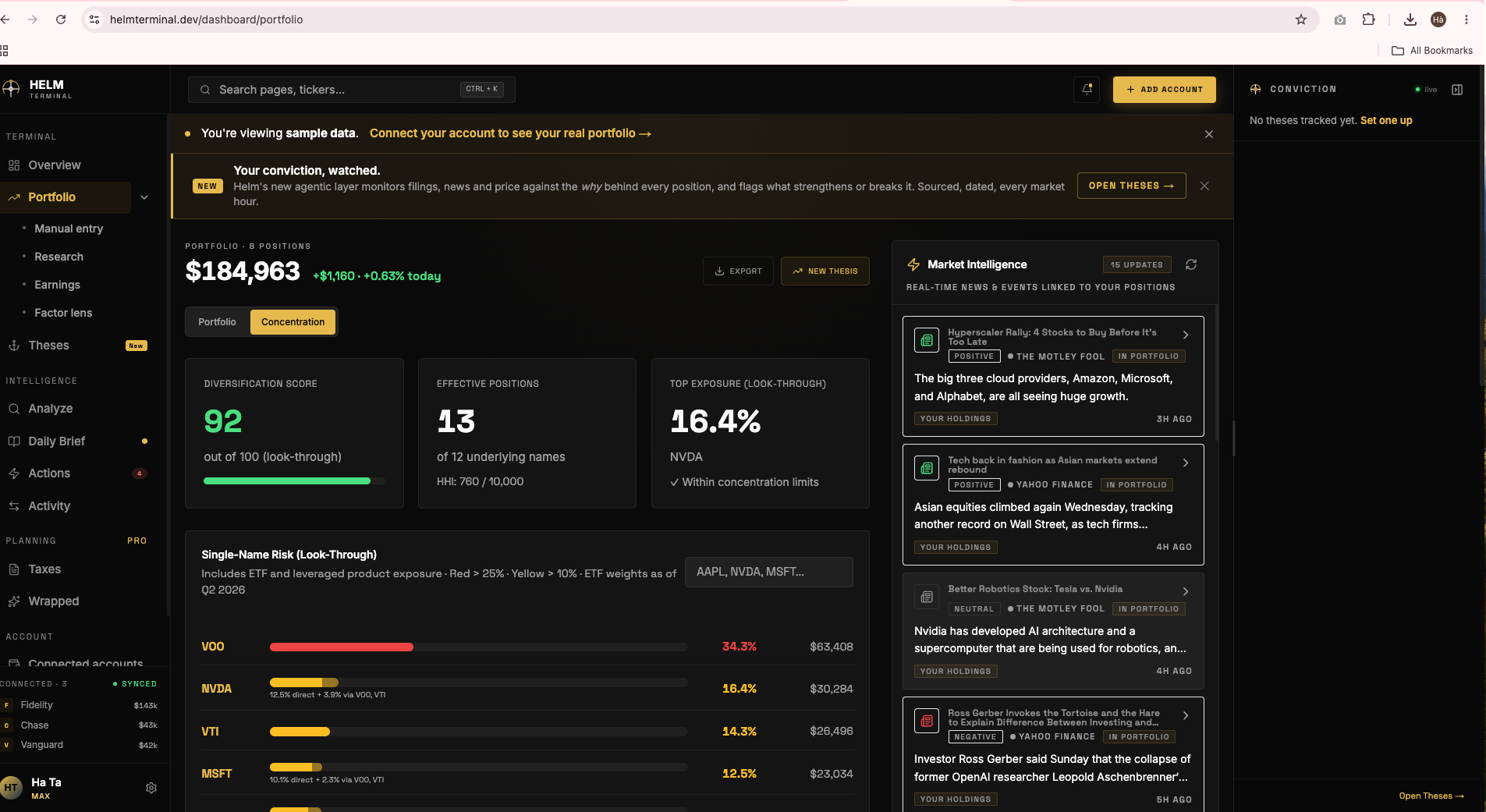
Helm Terminal already combines linked portfolios, thesis pillars, automatic event
monitoring, exact source evidence, prioritised actions and tax-aware context. subThesis
already combines version-controlled theses, assumptions, source-linked claims, decision
records, scenario branches and outcome review. Journalytic already captures decisions,
predictions, probabilities, feelings, checklists, opportunity cost and behavioural feedback.
MyThesis, Horyzon, ThesesWatch and SYNESI — each documented in this briefing from their own
product screenshots — add further variants of the same promise: a thesis, a threshold, an
alert.
What none of the seven does is carry that promise through to a decision, a capital
commitment and a resolved outcome. That gap is where this briefing ends up, in the final
section — and it is the shape of the opening for ClassicInvestor.
02 — The seven at a glance
Coverage across the eight journey stages
Product
Evidence
Analysis
Thesis
Decision
Portfolio
Monitoring
Outcome
Review
Full
Helm Terminal
Full
Part
Full
Unk
Full
Full
Part
Unk
4/8
subThesis
Full
Part
Full
Full
Part
Full
Full
Full
6/8
Journalytic
No
No
Part
Full
Part
No
Full
Full
3/8
MyThesis
Part
Part
Full
Unk
Part
Full
Unk
Unk
2/8
SYNESI
Part
Part
Full
Part
Part
Full
Part
Full
3/8
Horyzon
Part
Part
Full
Part
Full
Part
Part
Part
2/8
ThesesWatch
Part
Part
Full
Unk
Part
Full
Full
Part
3/8
Full — publicly evidenced as a first-class capability ·
Part — present but partial or incidental · No — evidenced as absent ·
Unk — not publicly evidenced either way. No and Unk are deliberately different:
a blank in the record is not a finding about the product. Every cell reflects only what was
observable in each product’s own material — marketing pages, app screenshots, documentation.
Where a capability did not appear in what was reviewed, the cell reads Unk, not No.
subThesis is the broadest at six of eight and is the one to watch. Every one of the seven
scores Full on Thesis — thesis creation is fully commoditised — while
Decision is the weakest column in the table. That is the shape of the opening.
Helm Terminal
Portfolio-linked thesis monitoring
helmterminal.dev
4 / 8stages covered
Does wellLinked portfolios, thesis pillars, automatic event monitoring, exact source evidence, prioritised actions and tax-aware context.
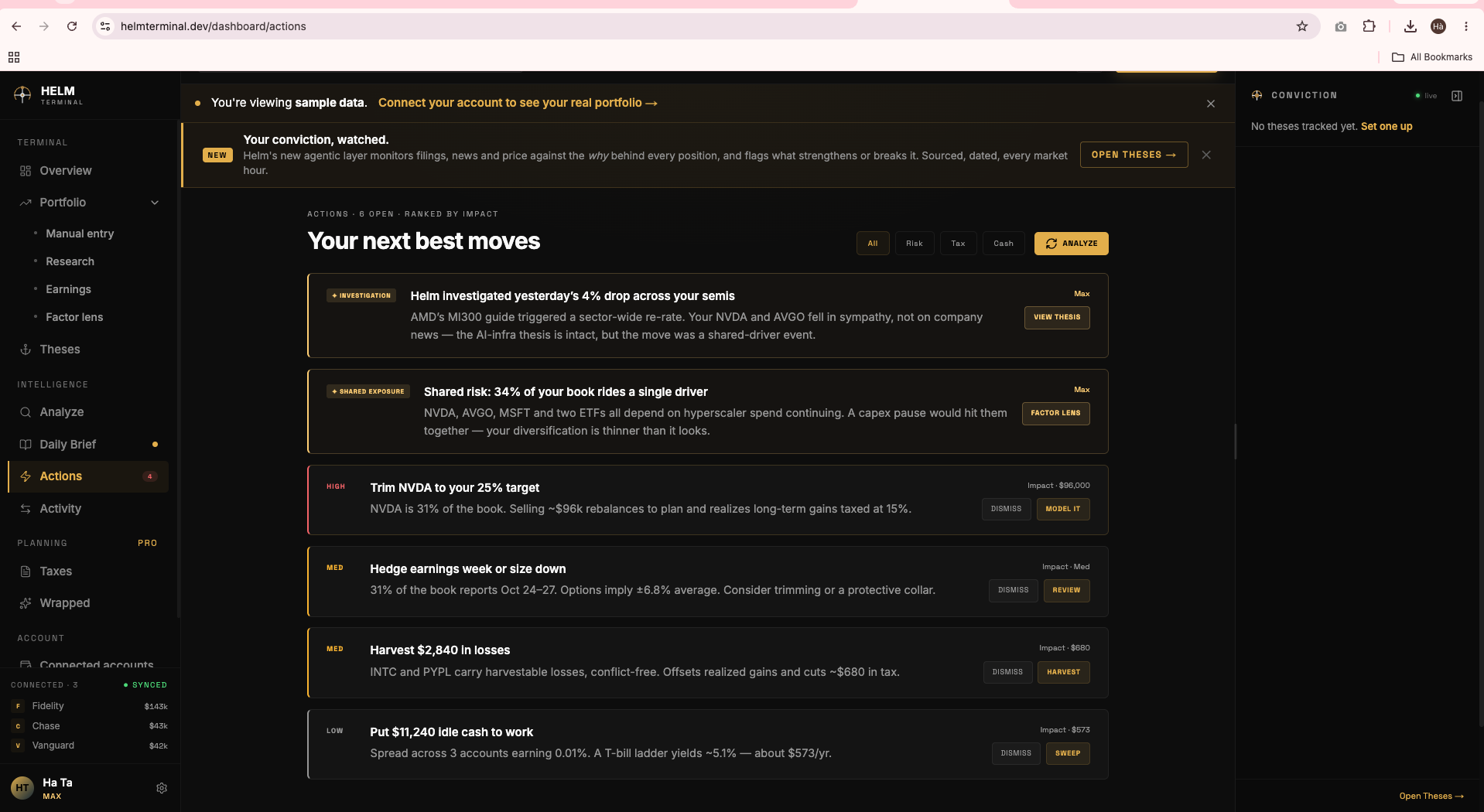
Stops atThe prioritised action. The record of what was decided, and whether it worked, is not the product.
We differKeep the evidence rigour, then carry the action into a decision and a resolved outcome.
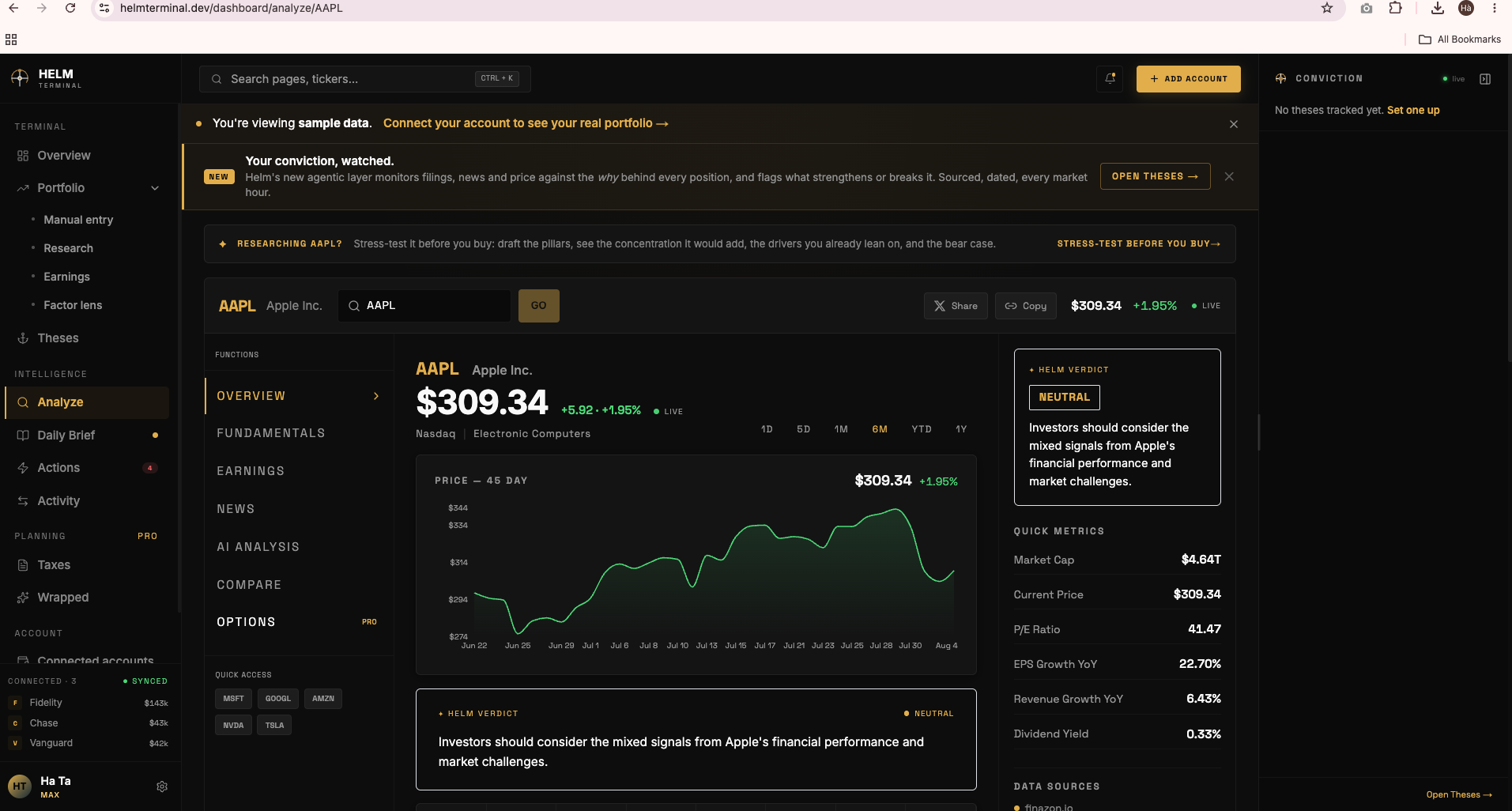
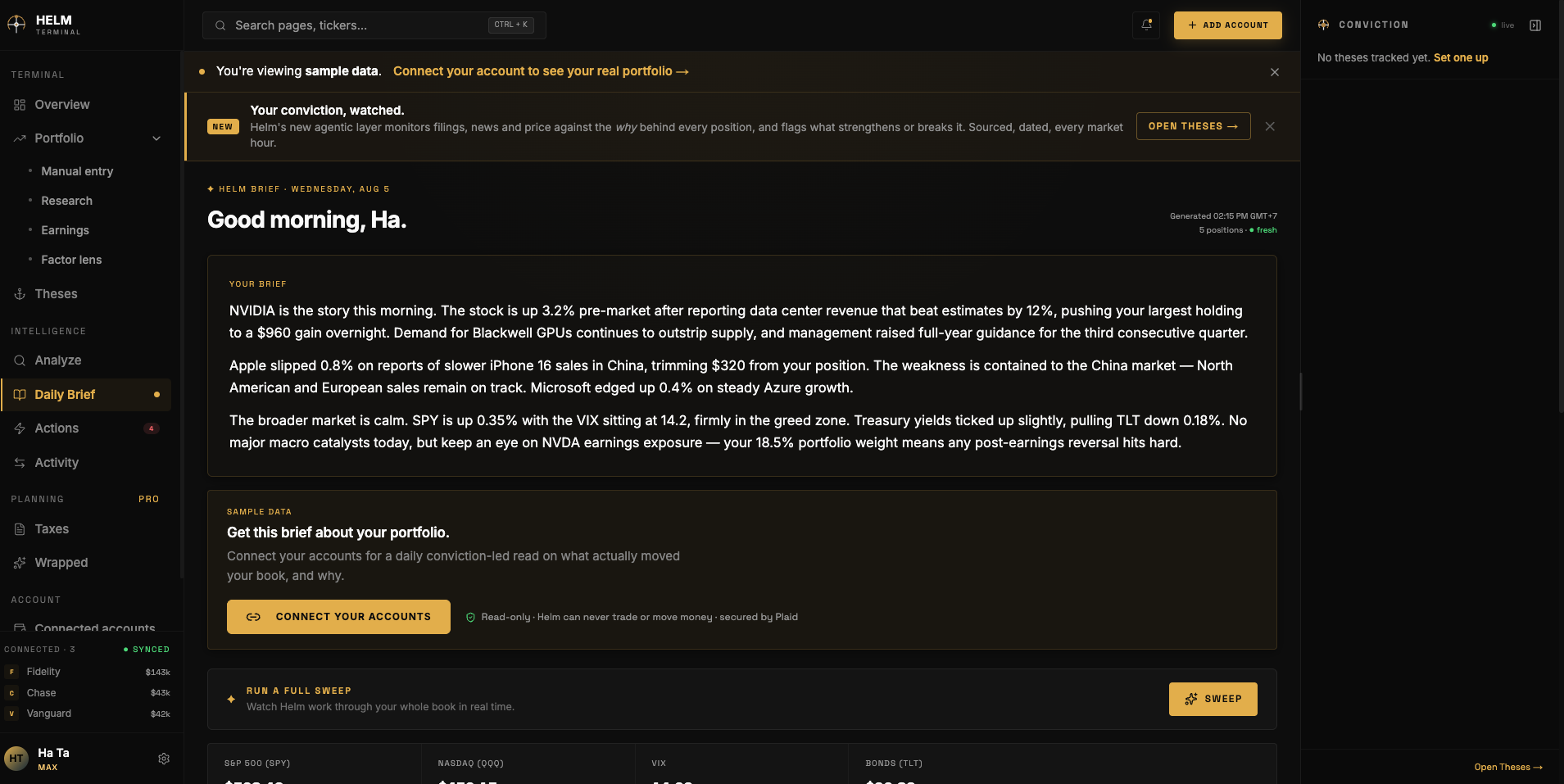
Helm TerminalPortfolio and thesis pillars presented together, so monitoring is anchored to real positions rather than a watchlist. Note the empty state on the right: “No theses tracked yet” — thesis-writing is a deliberate, separate step from connecting a portfolio.Helm TerminalEvents are matched to the pillar they bear on, with the source kept alongside the claim.Helm TerminalPrioritised actions — the product ends by telling the investor what to look at next.Helm TerminalTax-aware context sits inside the same surface, which is rare in this set.
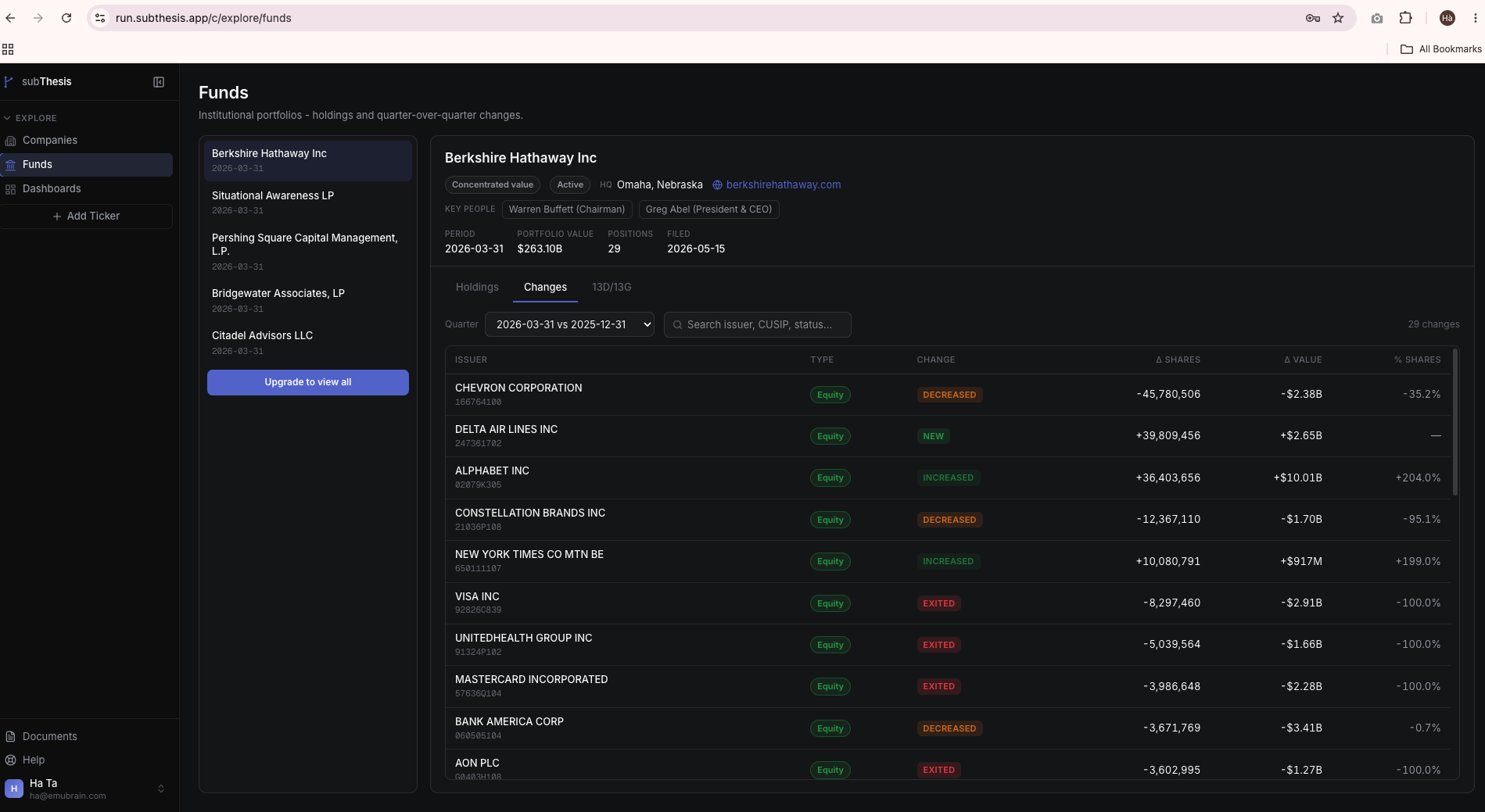
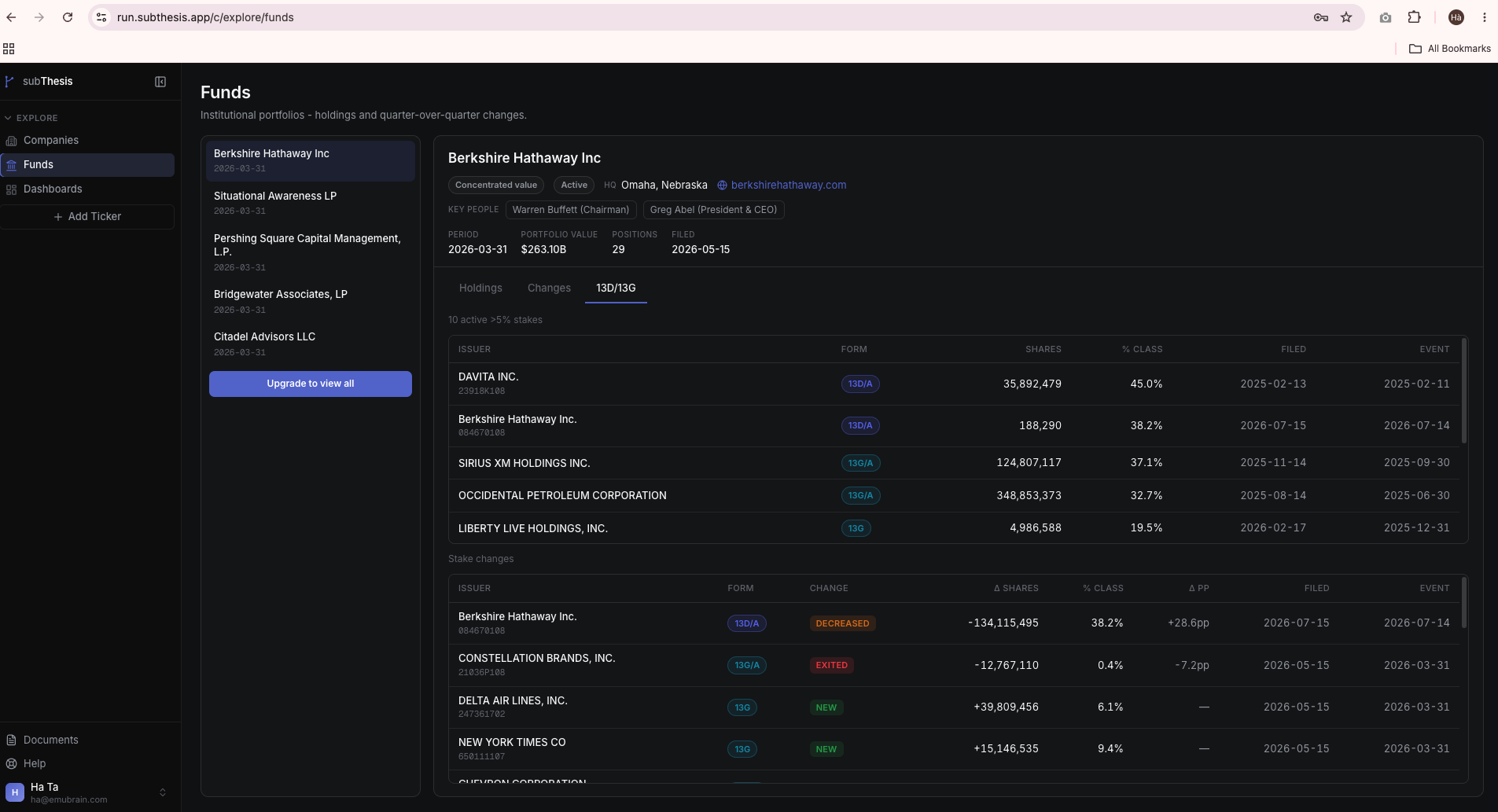
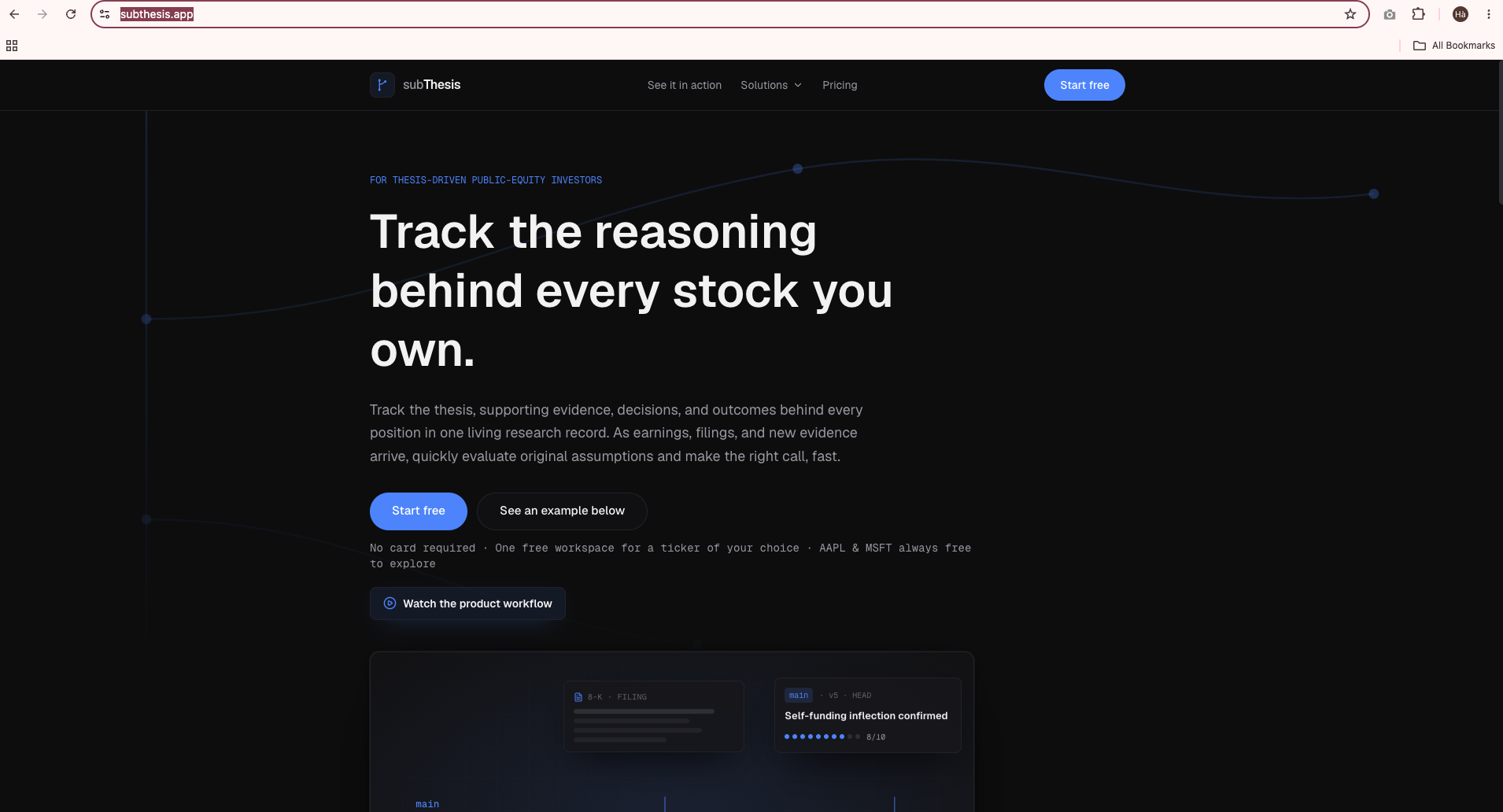
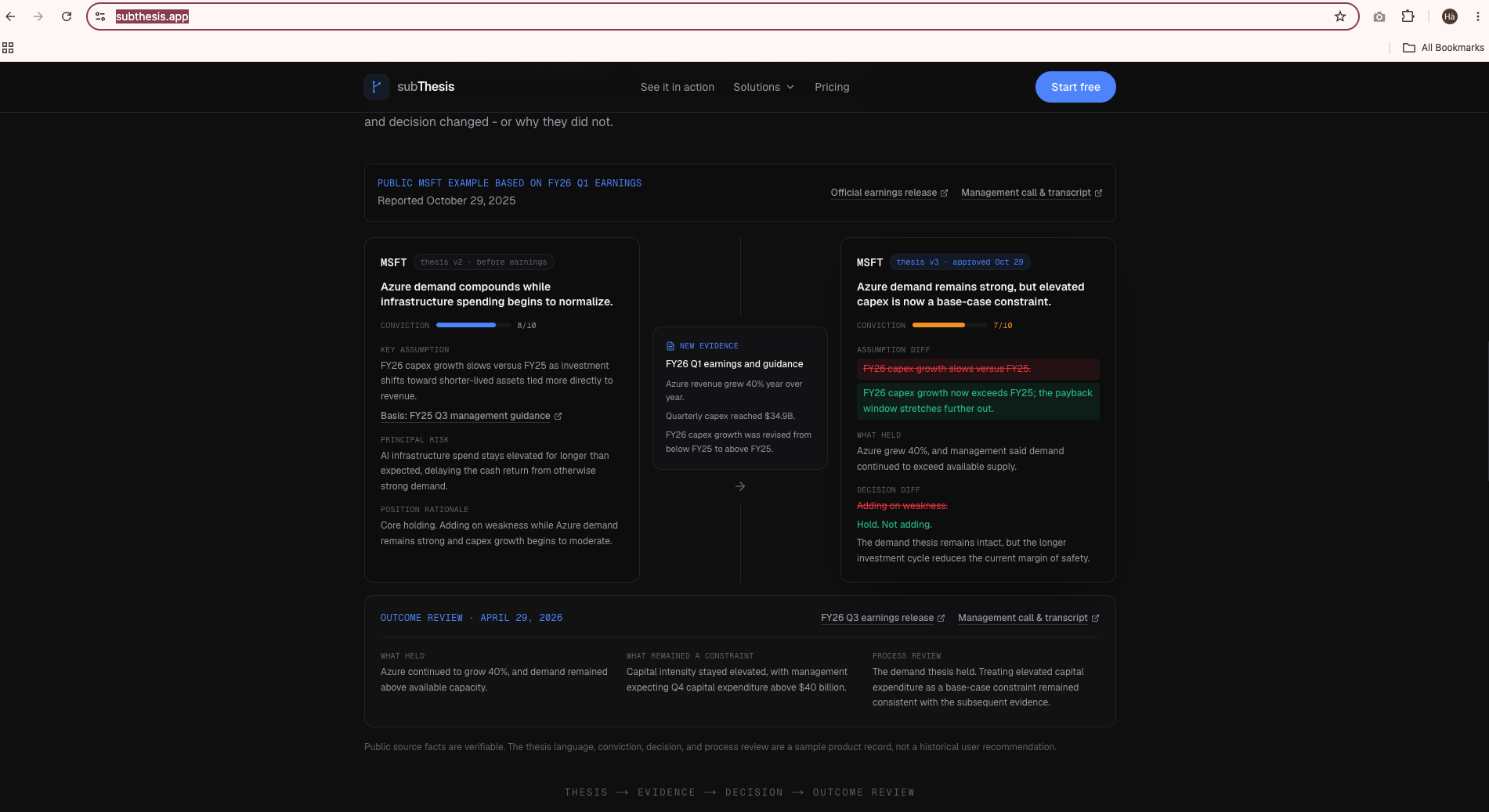
subThesis
Version-controlled thesis notebook
run.subthesis.app
6 / 8stages covered
Does wellVersion-controlled theses, explicit assumptions, source-linked claims, decision records, scenario branches and outcome review.
Stops atBest coverage in the set. It stops short of authoritative source ingestion and cross-company calibration.
We differAnchor the same structure to primary company evidence, and compound it across holdings.
subThesisTheses are versioned, so a change of mind is a diff rather than an overwrite.subThesisAssumptions are separated from claims and each claim carries its source link.subThesisScenario branches let one thesis carry several futures.subThesisOutcome review closes the loop — the strongest example of this in the set.
Journalytic
Decision journal and behavioural feedback
journalytic.com
3 / 8stages covered
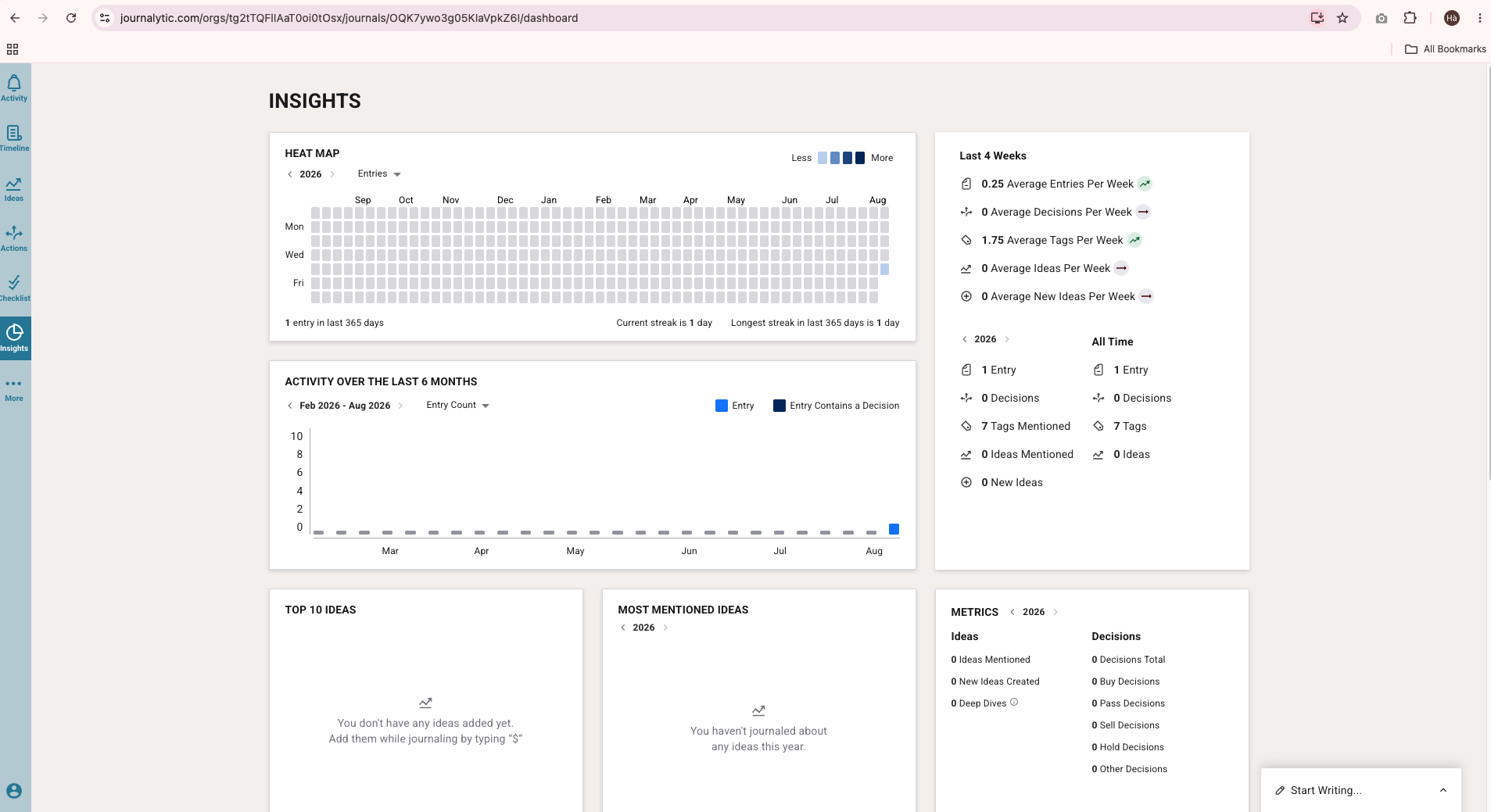
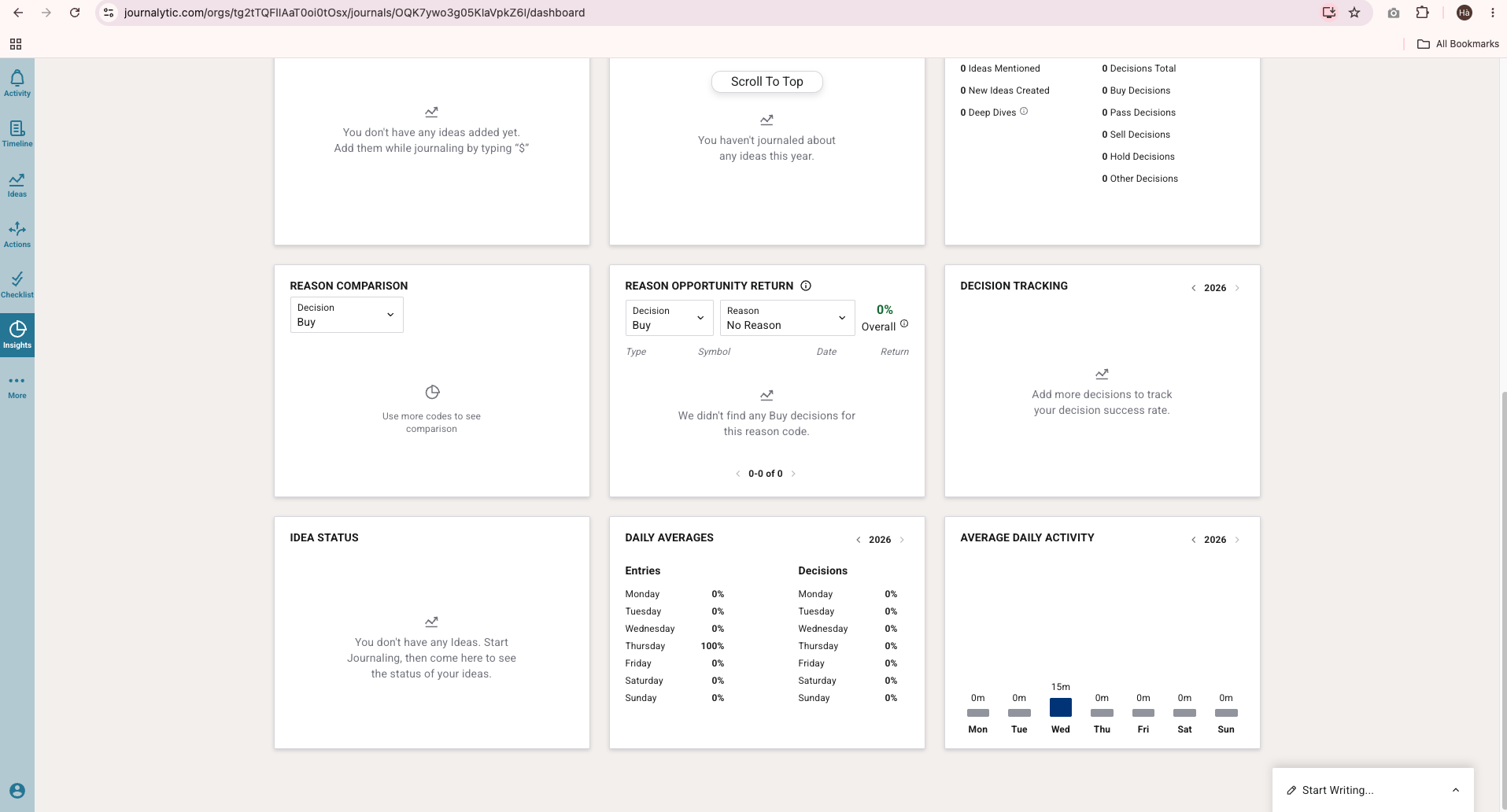
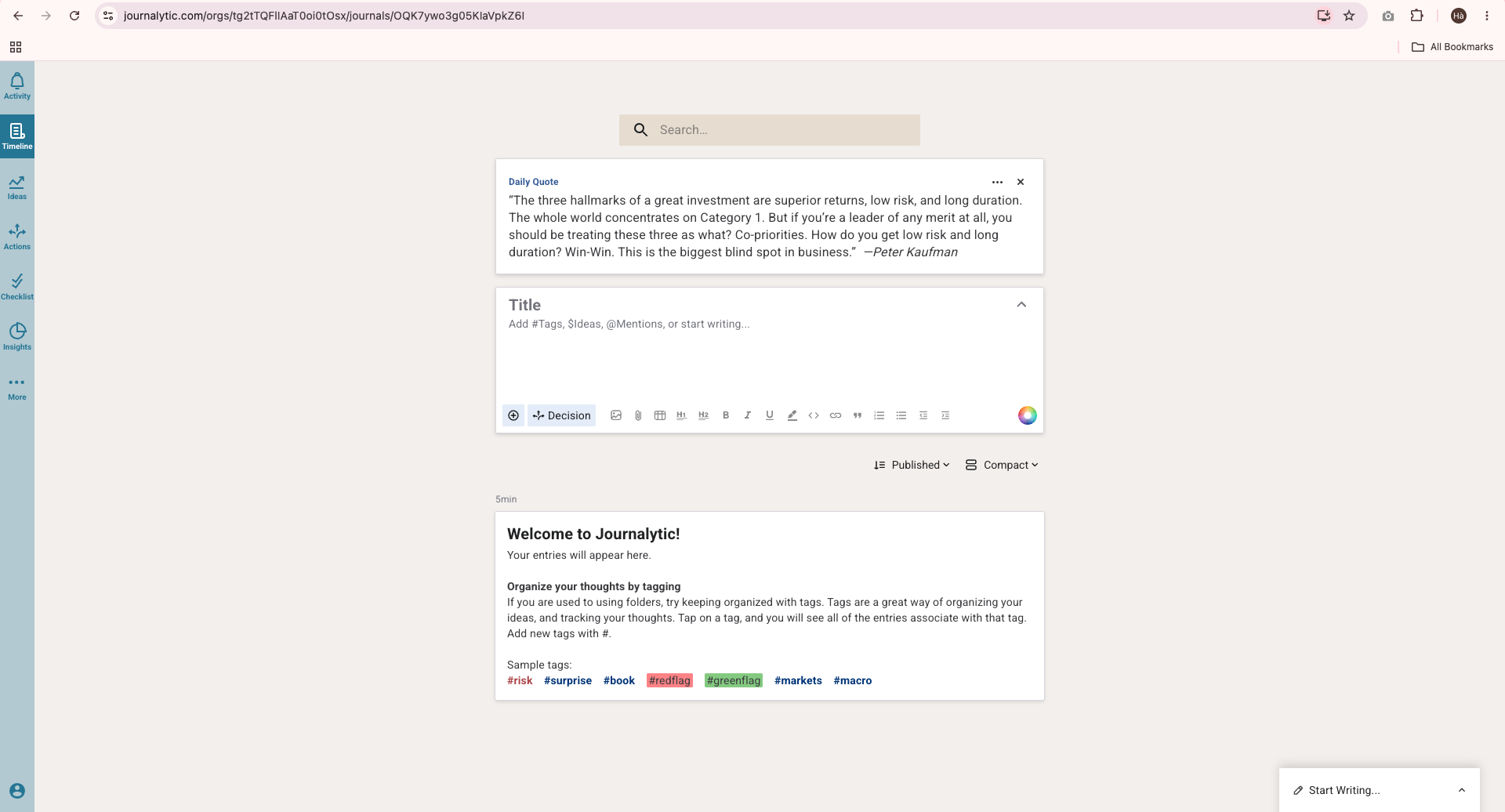
Does wellCaptures decisions, predictions, probabilities, feelings, checklists, opportunity cost and behavioural feedback.
Stops atThe journal. It is deliberately not a research tool, so evidence never enters the record.
We differTake the calibration discipline and attach it to evidence rather than to self-report alone.
JournalyticEvery entry is a decision with a probability attached — the basis for later calibration.JournalyticEmotional state and checklist adherence are captured as first-class fields.JournalyticBehavioural feedback is reported back to the investor over time.
MyThesis
Thesis decomposition and live tracking
mythesis.ai
2 / 8stages covered
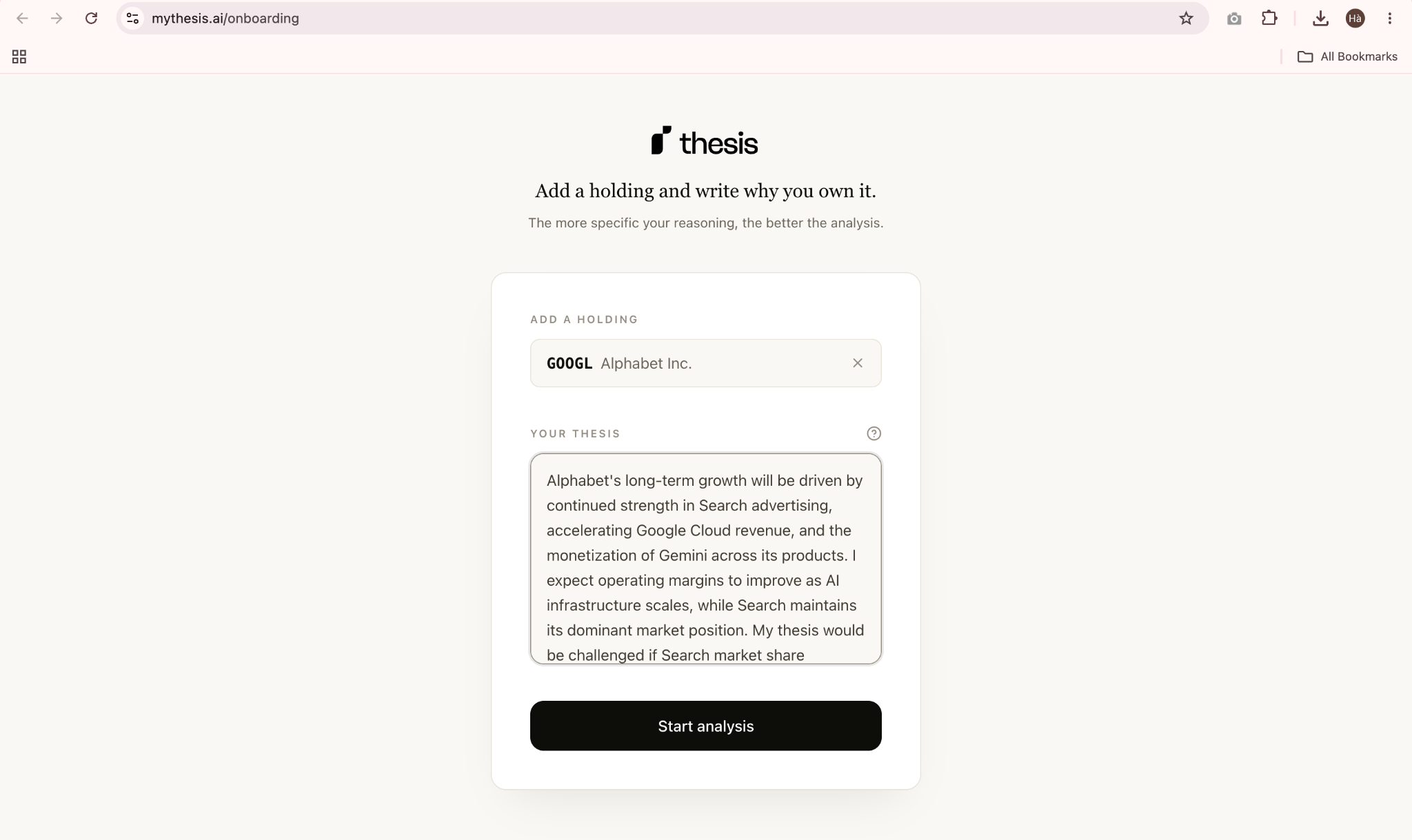
Does wellThe lowest-friction path from a written thesis to a tracked one. A prose thesis is decomposed into individual claims, each carrying its own state and its own evidence count against a continuously scanned event stream.
Stops atThe verdict. Thin decision history, limited calibration, and the source depth stays at headline level.
We differUse verdicts only as summaries. Keep the exact evidence, the changed assumption, the alternative readings and the resolution criteria.
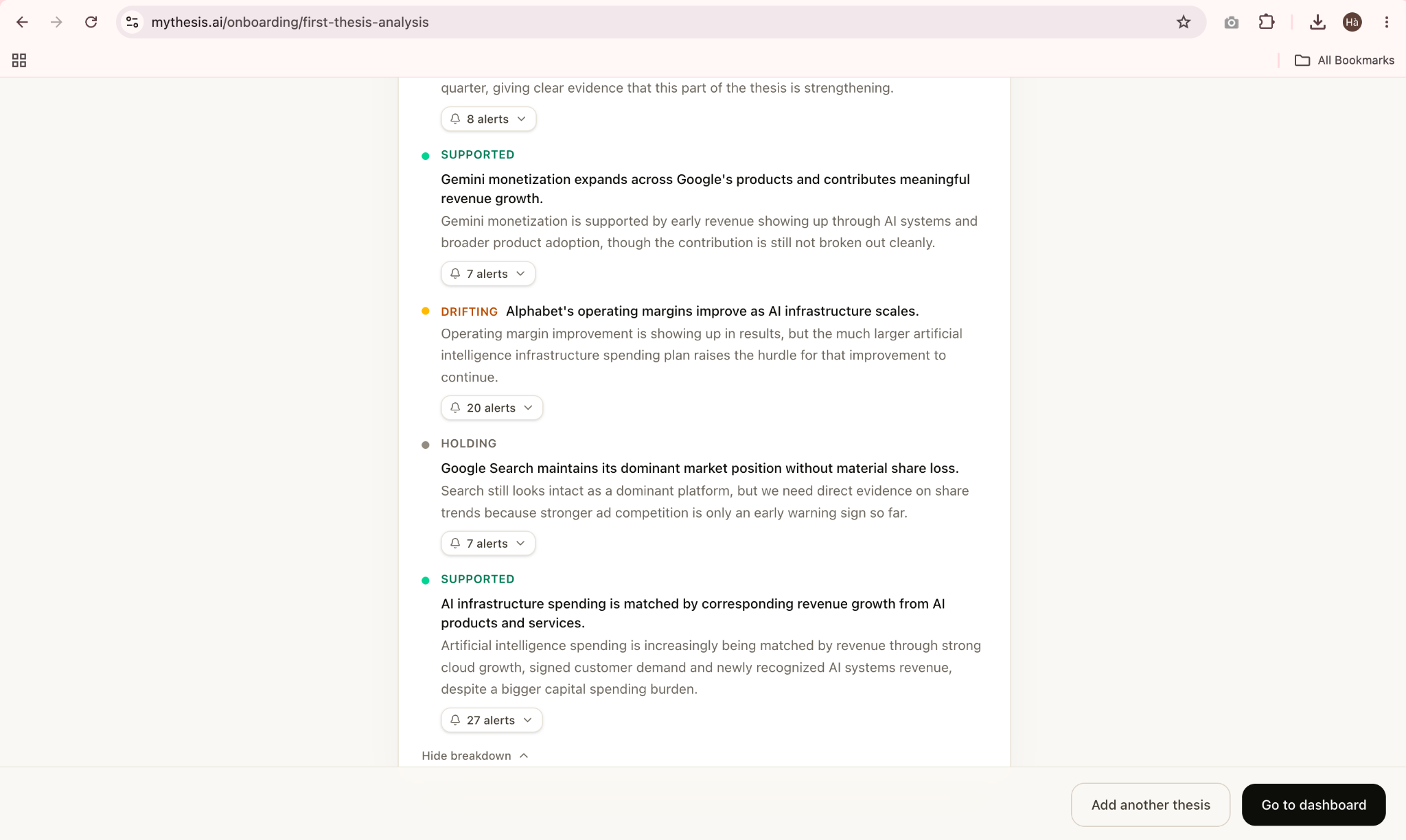
Worth notingMyThesis reports three states, not two — Supported, Drifting and Holding. “Drifting” is a genuinely useful middle term, worth borrowing into our own vocabulary.
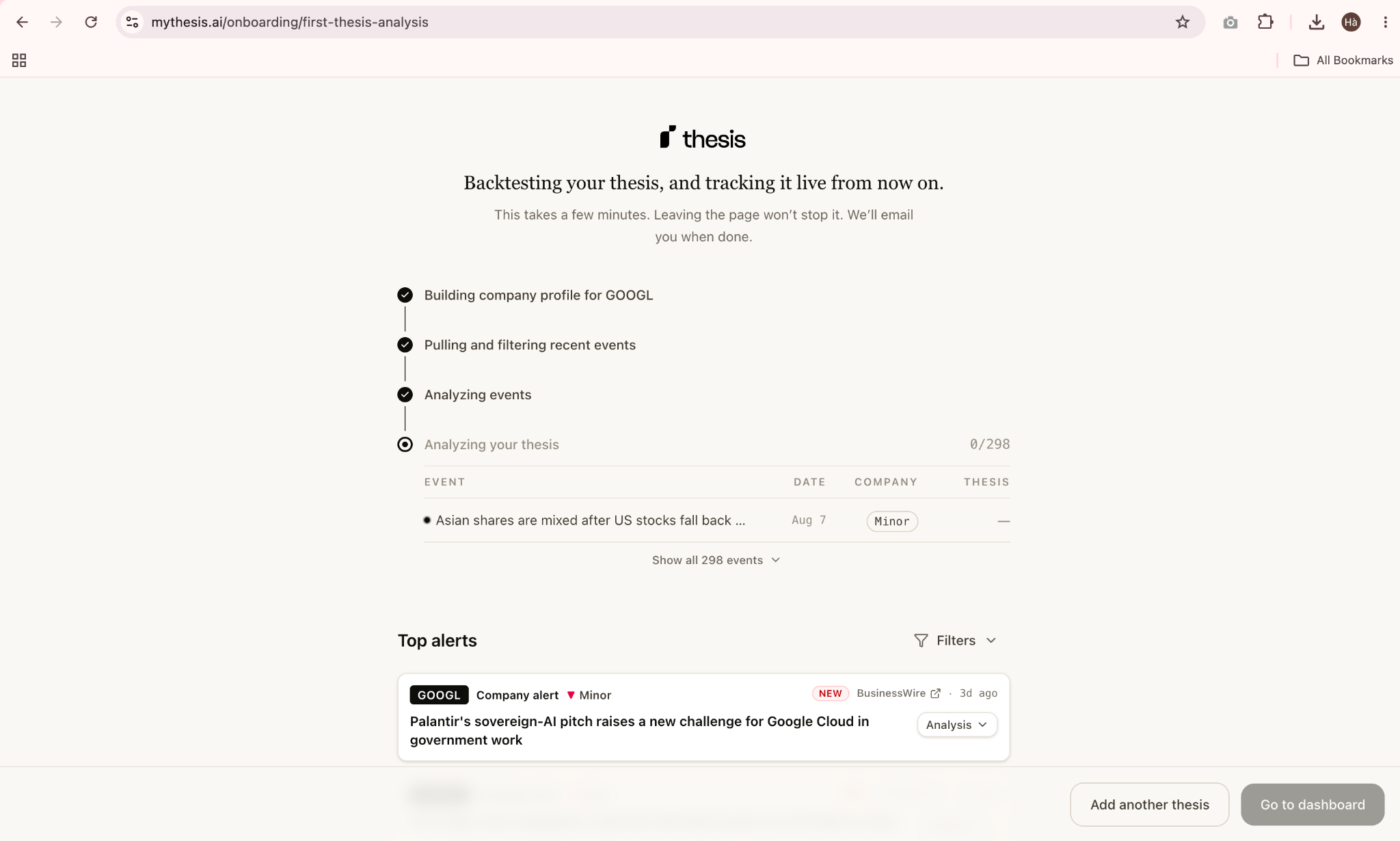
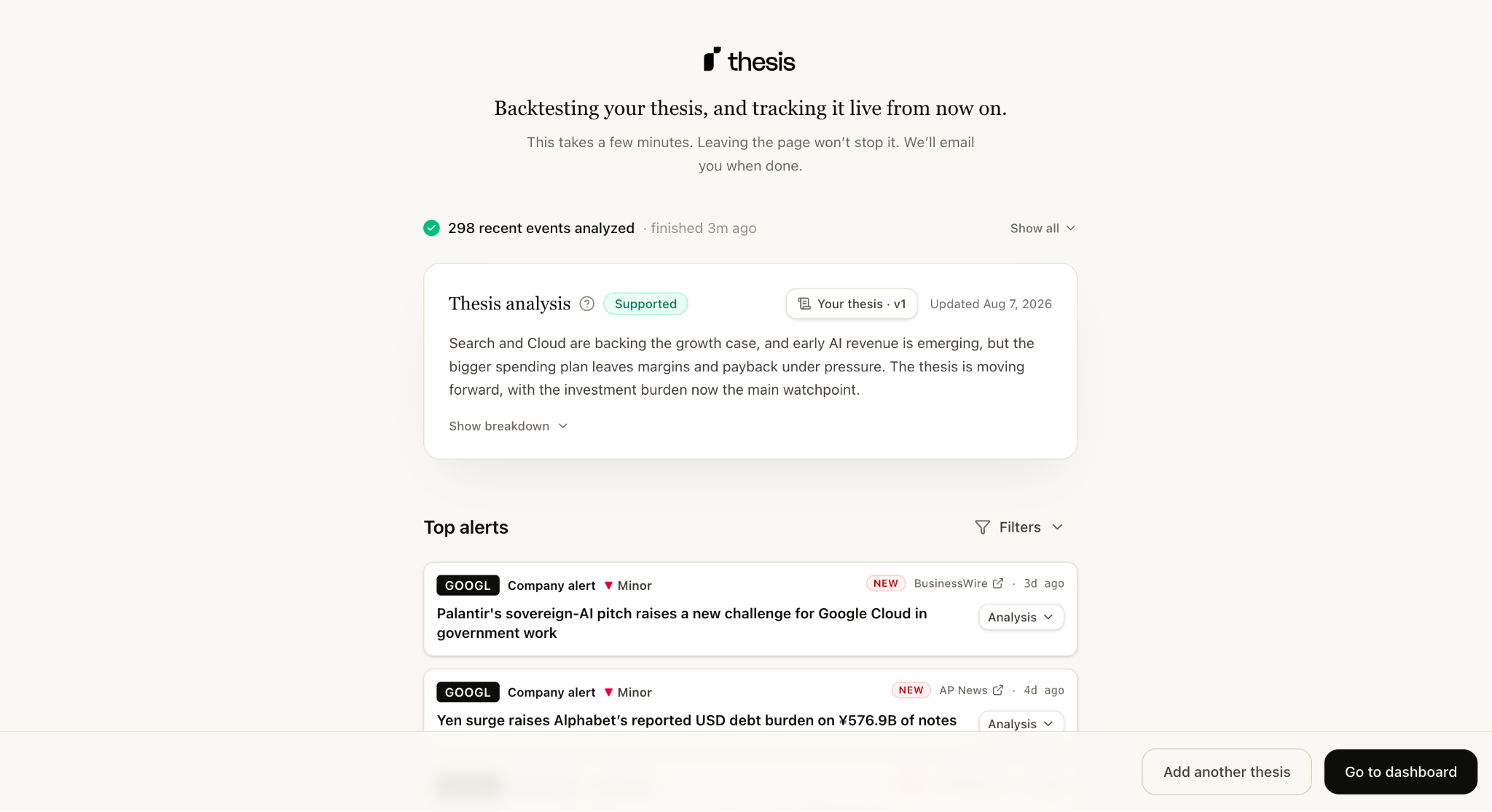
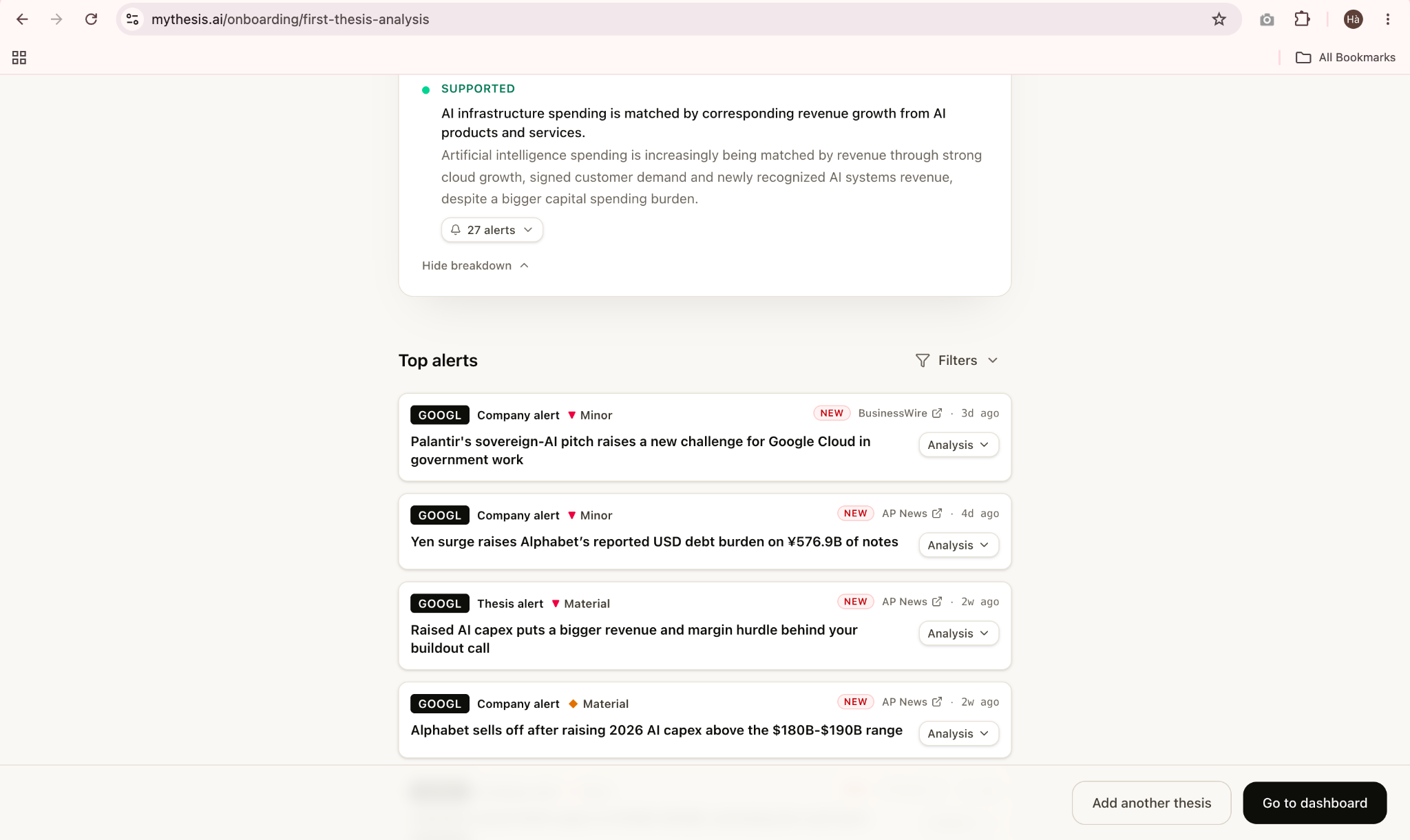
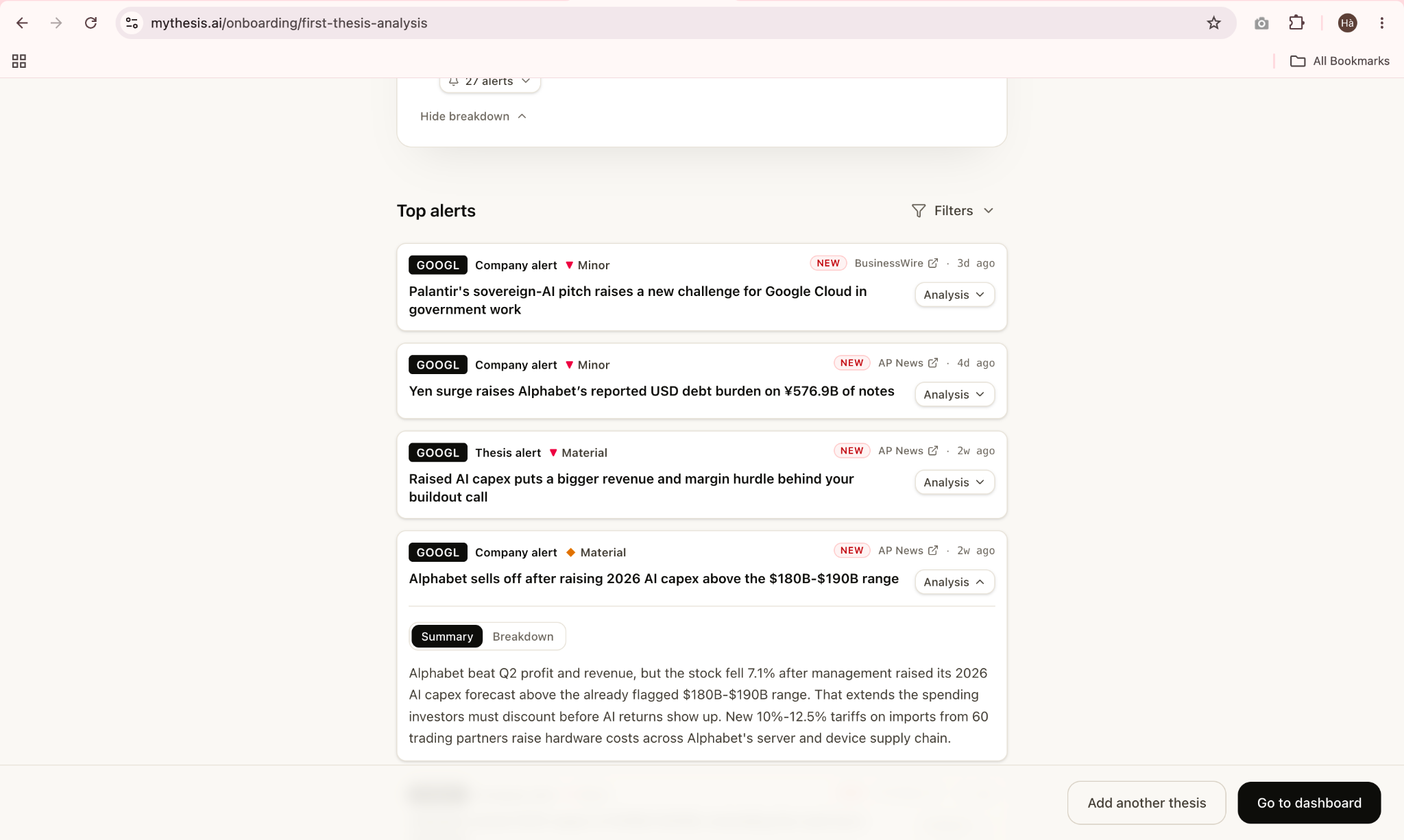
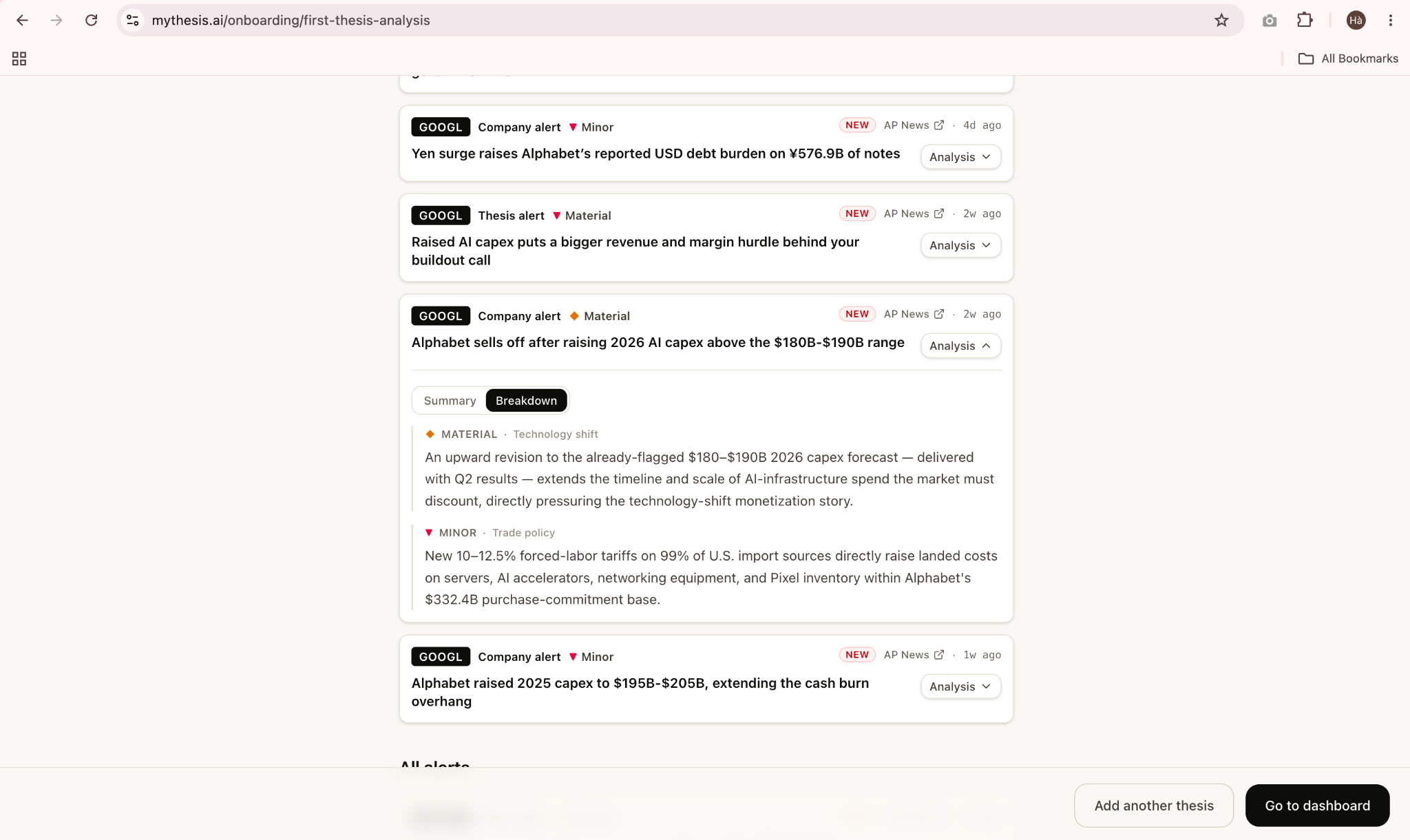
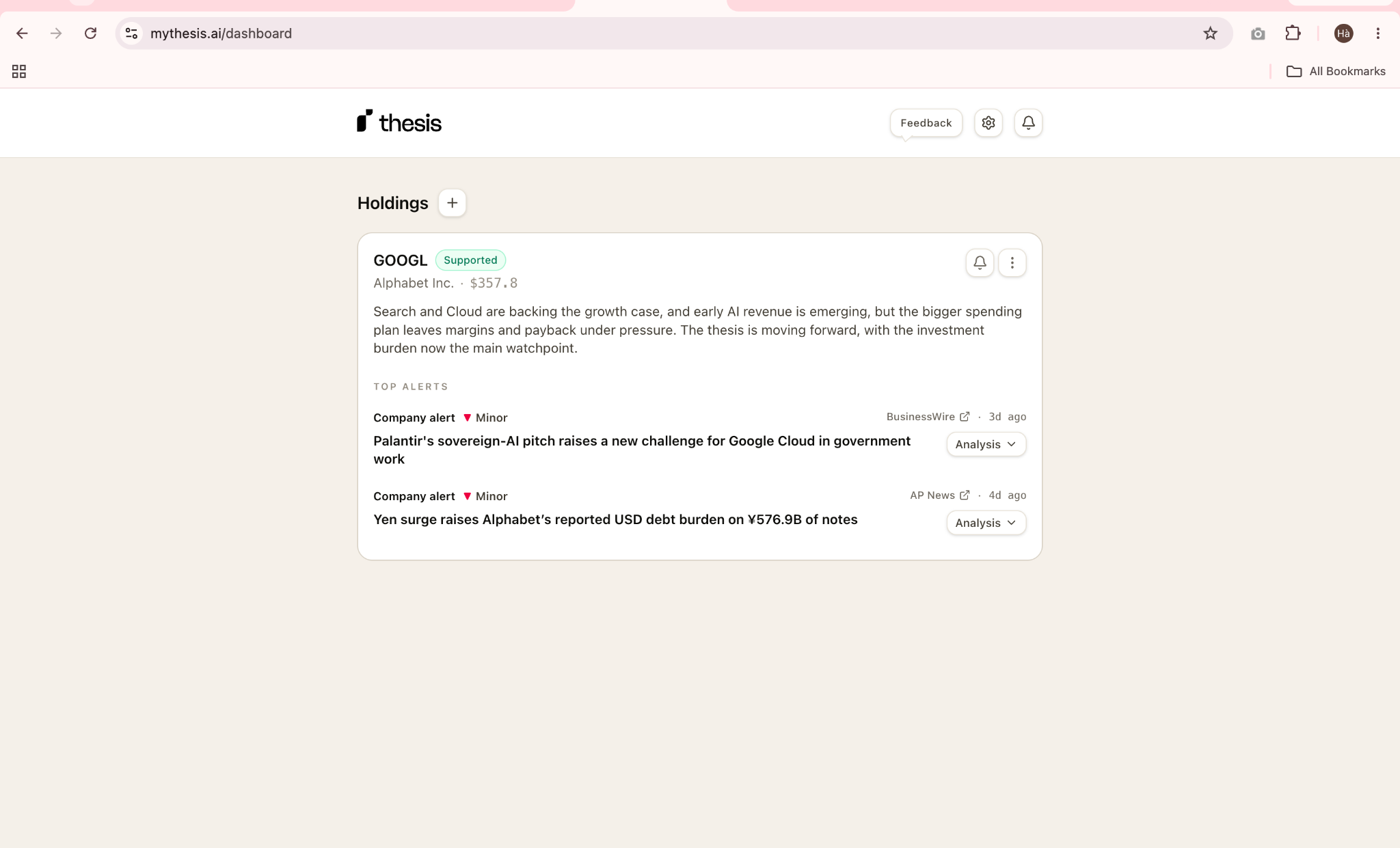
MyThesisOnboarding is a ticker and free prose. There are no required fields for risk, horizon or invalidation — the whole thesis is one text box.MyThesisThe analysis runs as a visible four-stage pipeline against 298 retrieved events, and says so while it works.MyThesisThe result is a single verdict chip over a plain-language summary — and the thesis is versioned, “Your thesis · v1”.MyThesisThe most important screen in this product. The prose thesis has been decomposed into separate claims, each with its own state — Supported, Drifting, Holding — and its own evidence count (7, 20, 27 alerts).MyThesisThe feed separates a Company alert from a Thesis alert, and grades each Minor or Material. That distinction is the product working.MyThesisEach alert opens to a Summary written against the investor’s position, not a generic news abstract.MyThesisOr to a Breakdown, which classifies the driver — Technology shift, Trade policy — and ties it back to the user’s own claim.MyThesisThe dashboard is one card per holding: verdict, price, summary, top alerts. Simple, and the whole product.
Horyzon
Mobile portfolio tracker with a reasoning layer
horyzonapp.com
2 / 8stages covered
Does wellMobile-first and genuinely low friction. A thesis is attached to each holding through two structured prompts, with a conviction scale and an intended holding period. Goals and milestones sit alongside.
Stops atLightweight tracking. There is no research depth, and the AI reasons over the investor’s own notes rather than over company evidence.
We differA different user entirely. We should not chase this simplicity at the cost of the record — but the two prompts below are worth taking.
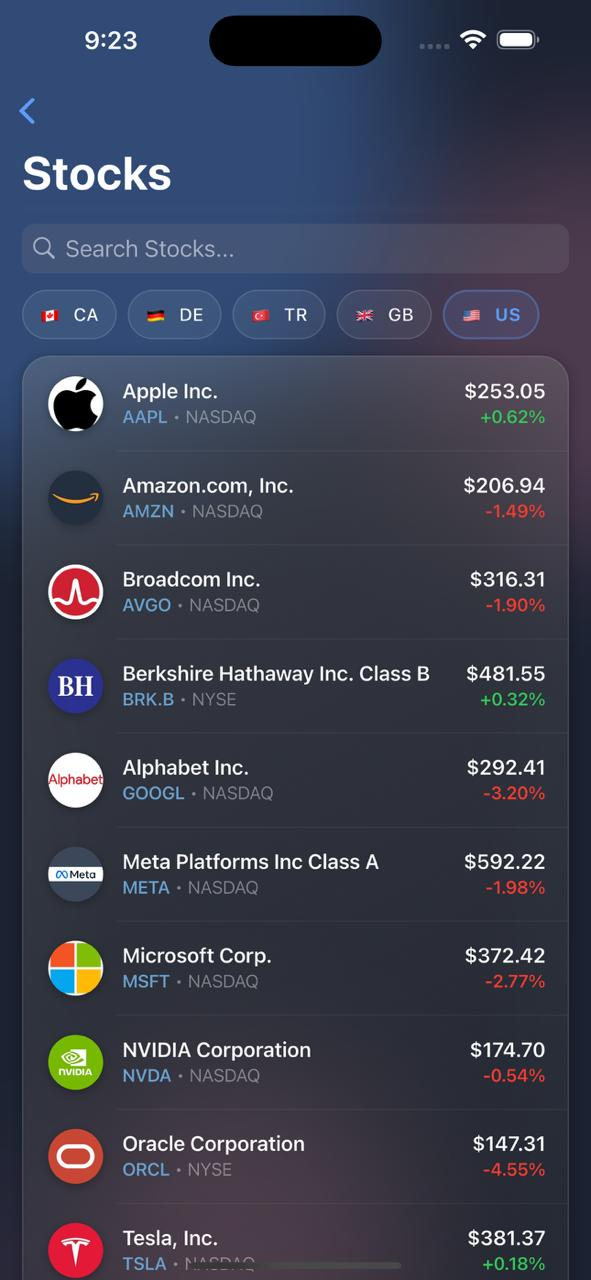
Worth notingThis is a phone product with a marketing site, not a desktop tool — six of the seven captures are portrait phone screens, shown as thumbnails below rather than full pages.
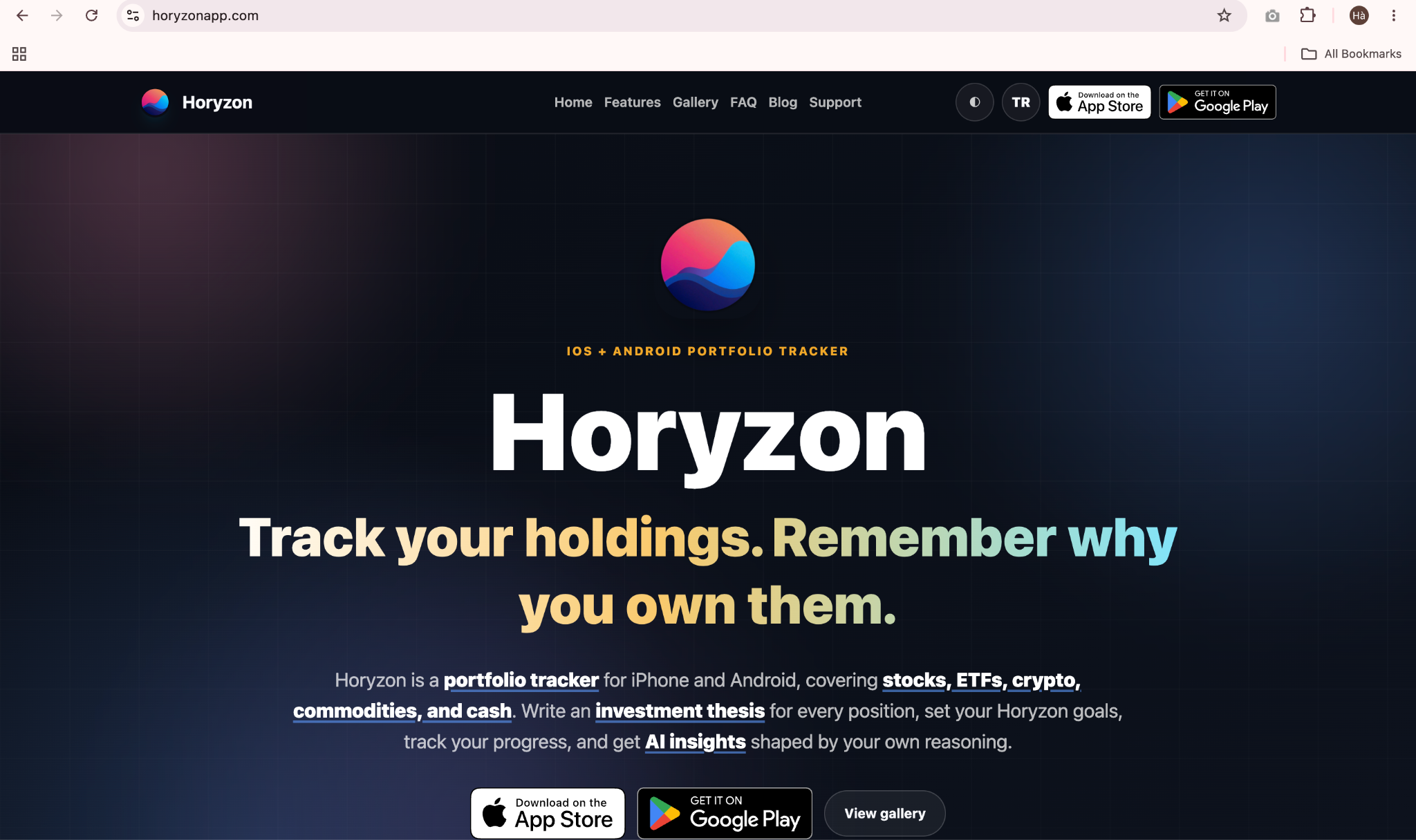
HoryzonThe positioning is explicit and narrow — an iOS and Android portfolio tracker. “Track your holdings. Remember why you own them.”Horyzon · mobile captures
123456
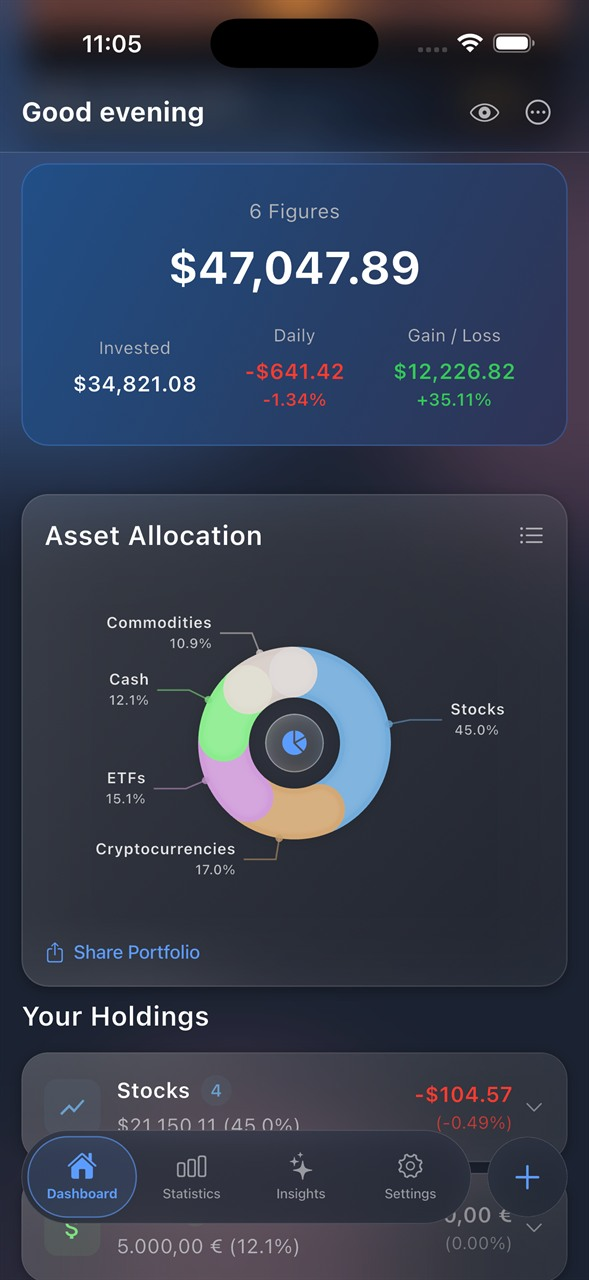
The home screen is valuation and allocation. The thesis is a layer on top of a tracker, not the primary object.
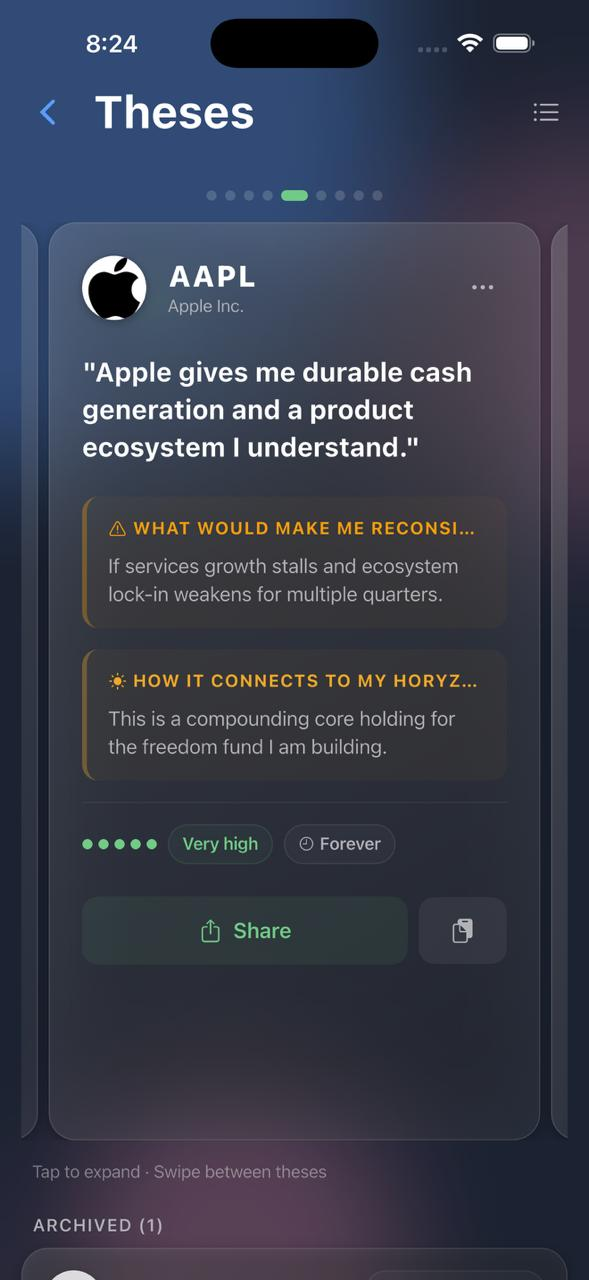
The thesis card, and the one thing worth stealing: two structured prompts — “What would make me reconsider” and “How it connects to my Horyzon” — plus a five-dot conviction scale and a holding period of “Forever”.
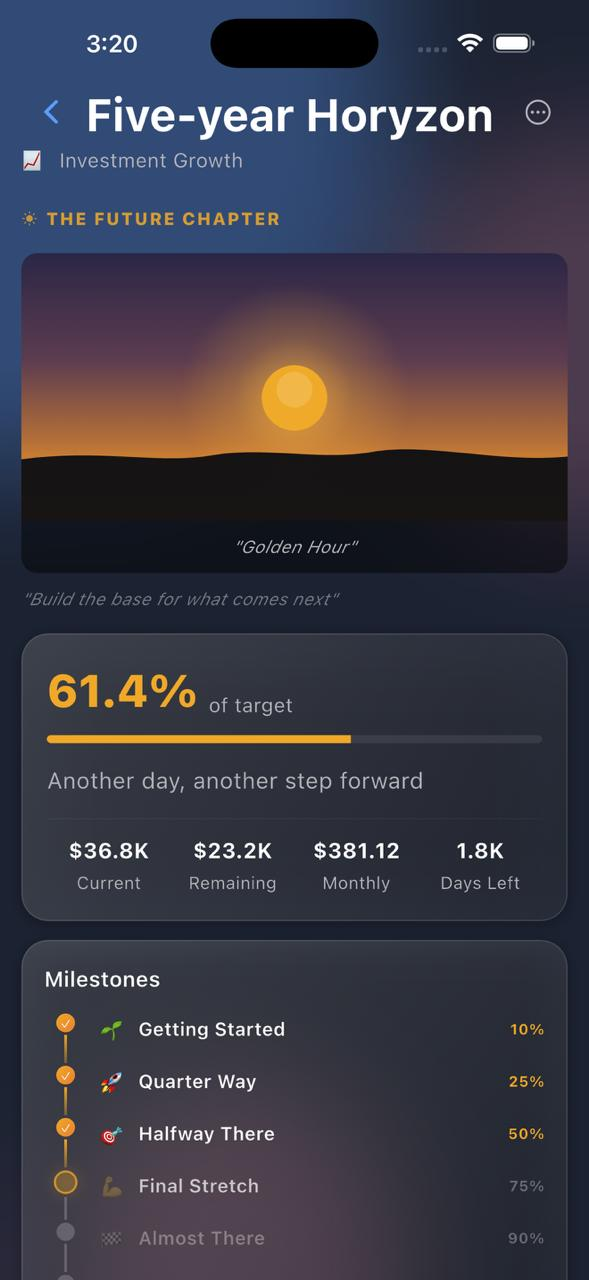
Goals rather than research. A five-year target at 61.4% with a milestone ladder — a consumer motivation device with no analogue in the institutional products.
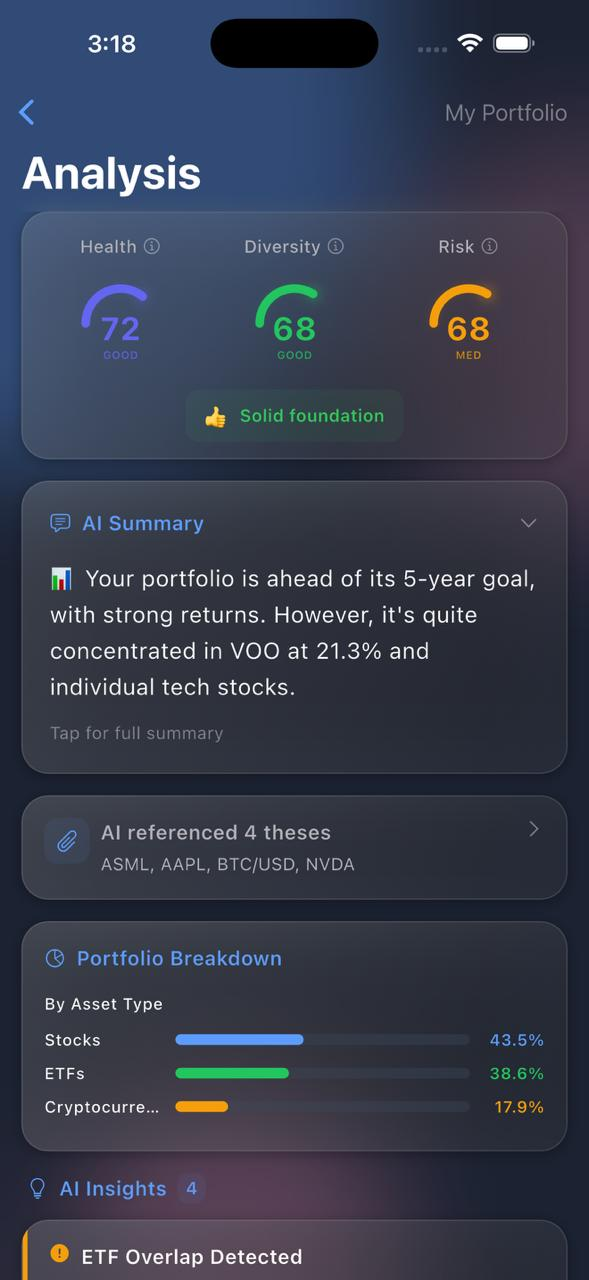
Analysis is three composite scores and an AI summary. Note the line “AI referenced 4 theses” — it names which of the investor’s own notes it read.
Instrument search across five markets. Breadth of coverage, no depth of evidence.
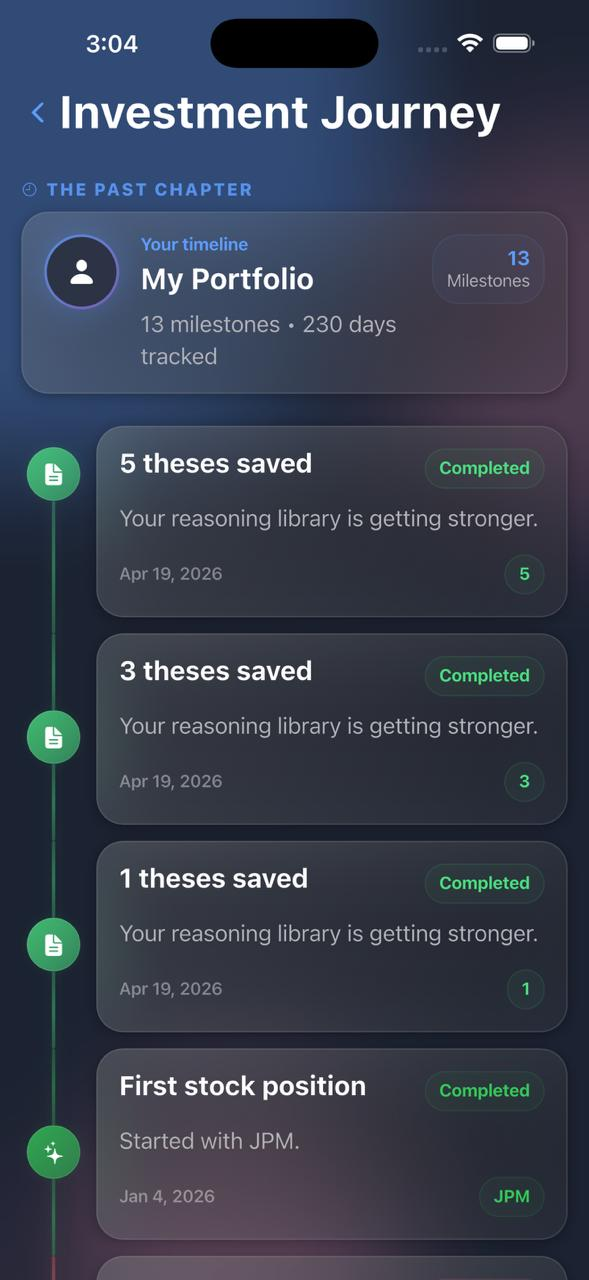
The journal is framed as a journey: “5 theses saved — Your reasoning library is getting stronger.” Volume is treated as progress.
ThesesWatch
Quantified thresholds and invalidation rules
thesiswatch.com — domain is singular “thesis”, the product name is plural “Theses”
3 / 8stages covered
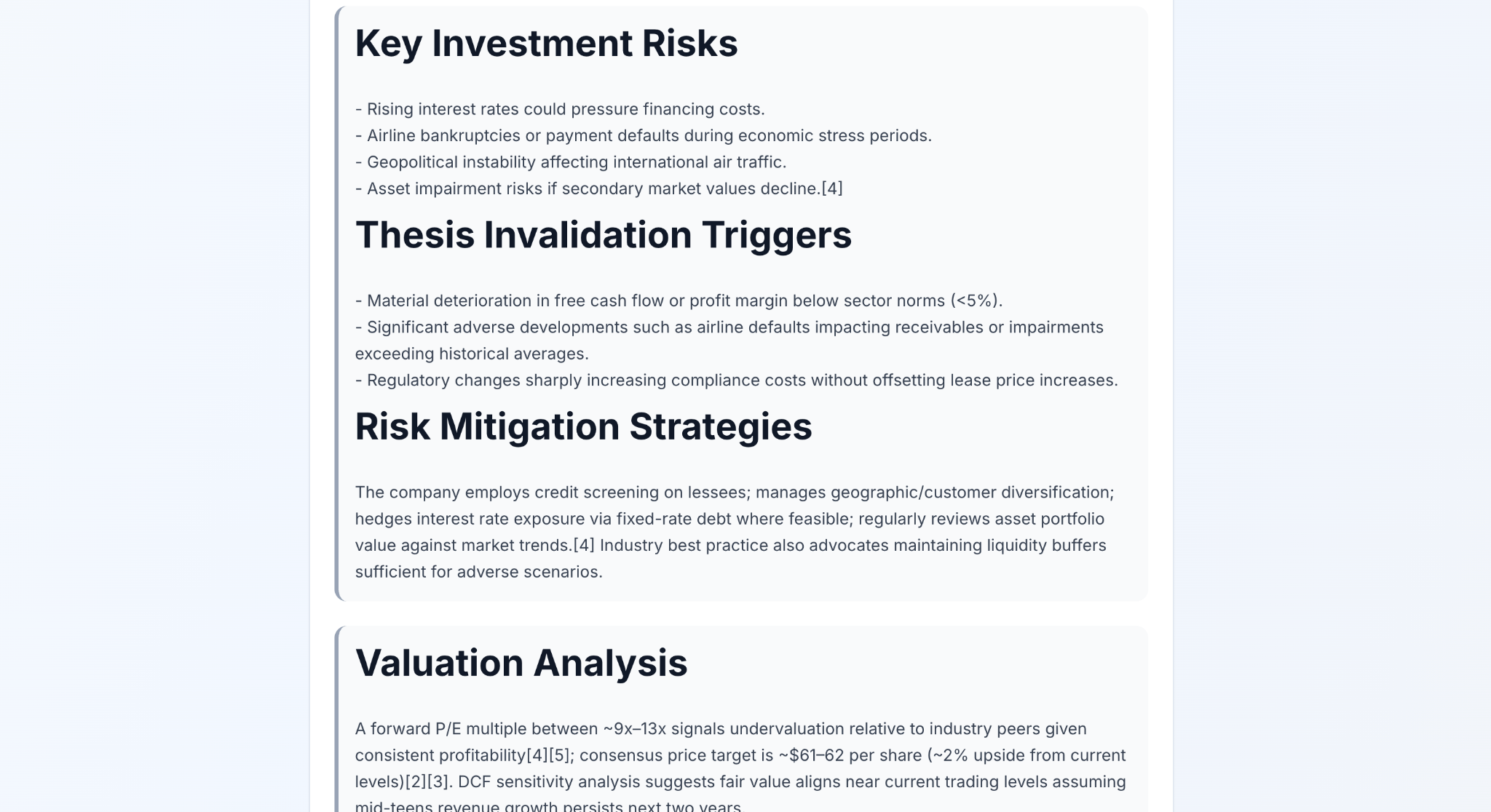
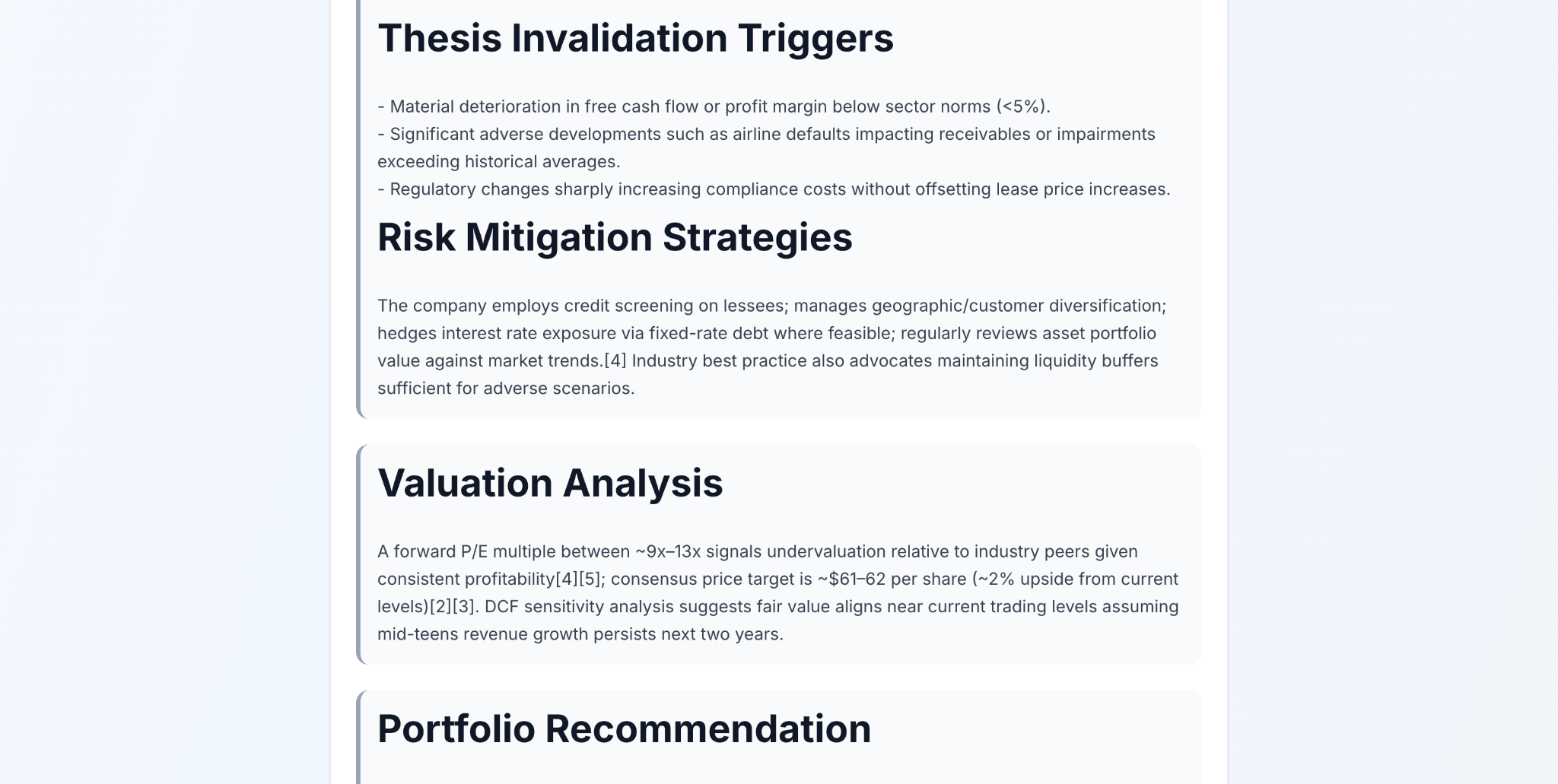
Does wellThe most operationalised falsification in the set. The investor selects which metrics constitute the thesis, commits to an expected value on each, and sets an alert sensitivity. “Thesis Invalidation Triggers” is a named, quantified section of every document.
Stops atThe threshold alert. A breach notifies; it does not become a decision or a resolved outcome.
We differKeep the numeric rigour, then carry the breach into a decision and a resolved outcome.
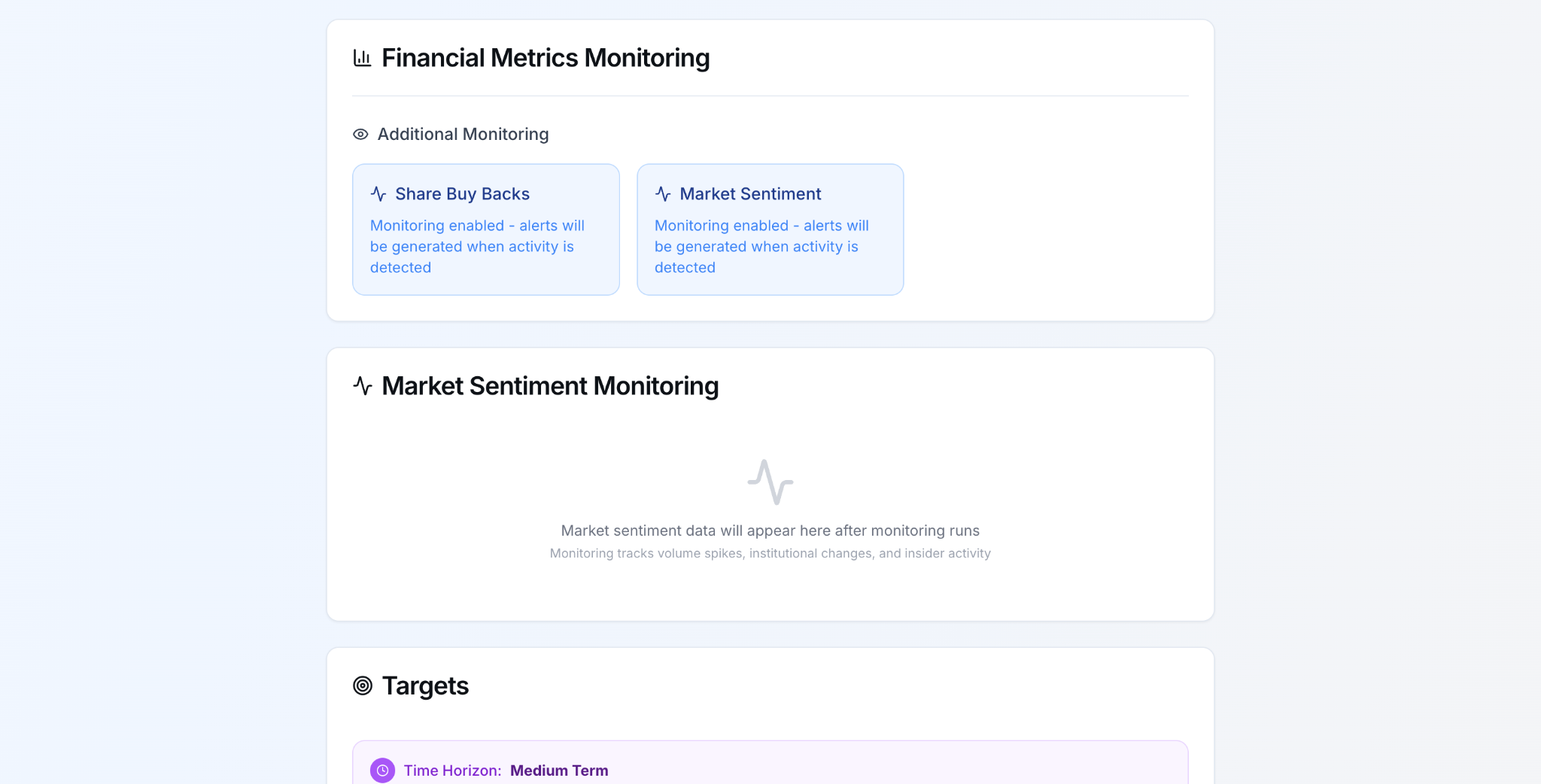
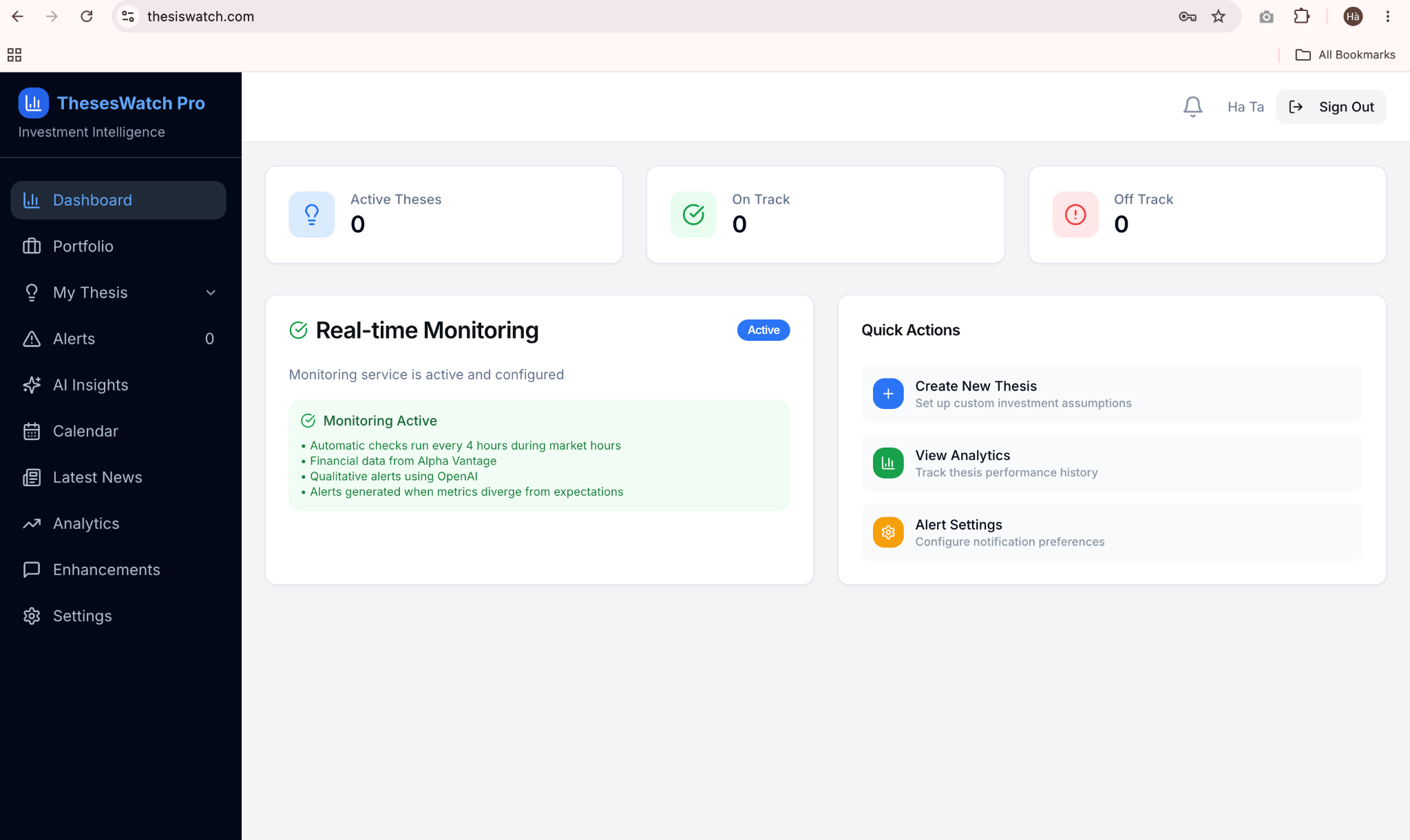
Worth notingThe product discloses its own mechanics in the surface itself — automatic checks every four hours during market hours, financial data from Alpha Vantage, qualitative alerts from OpenAI. A useful read on how thin the moat is under this category.
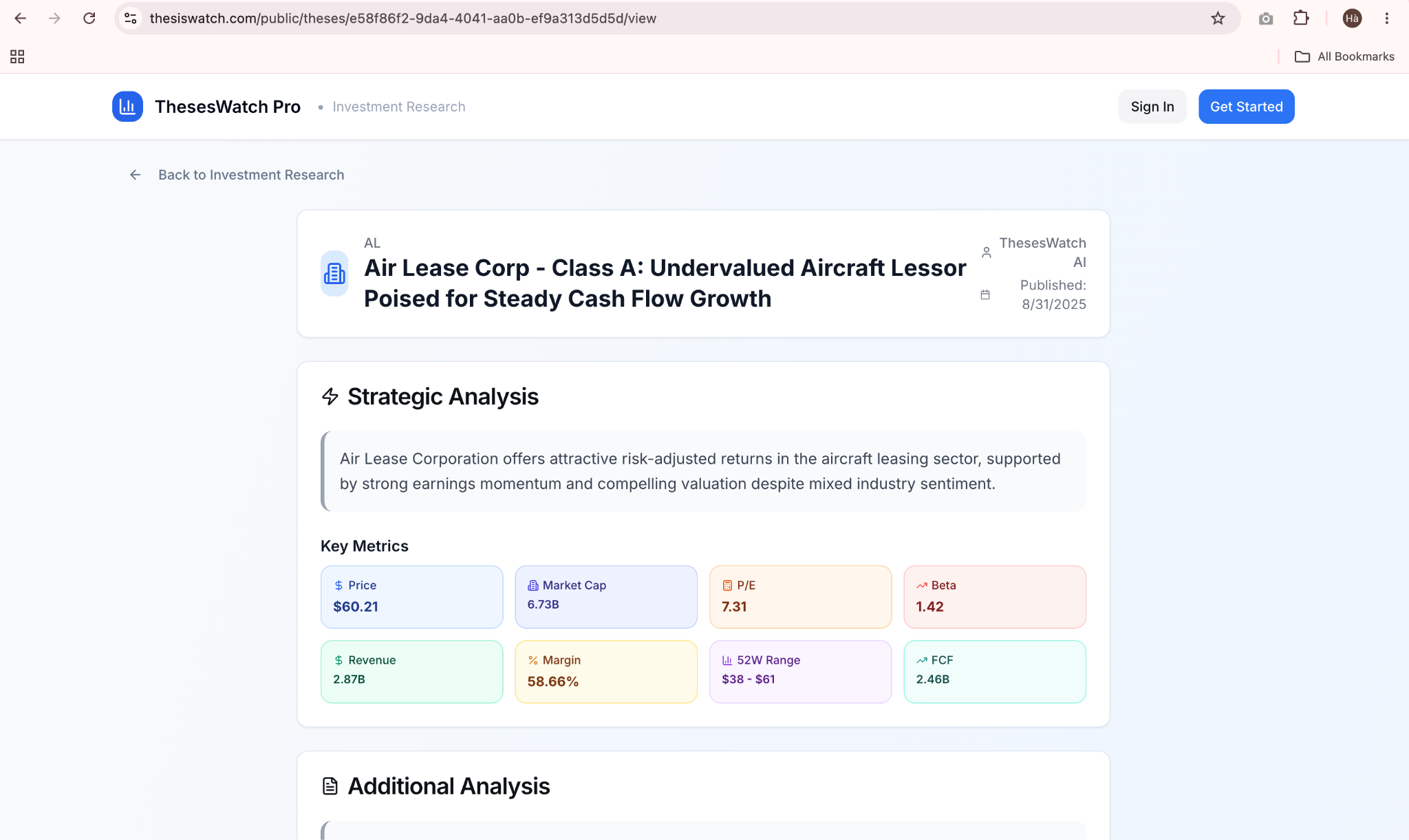
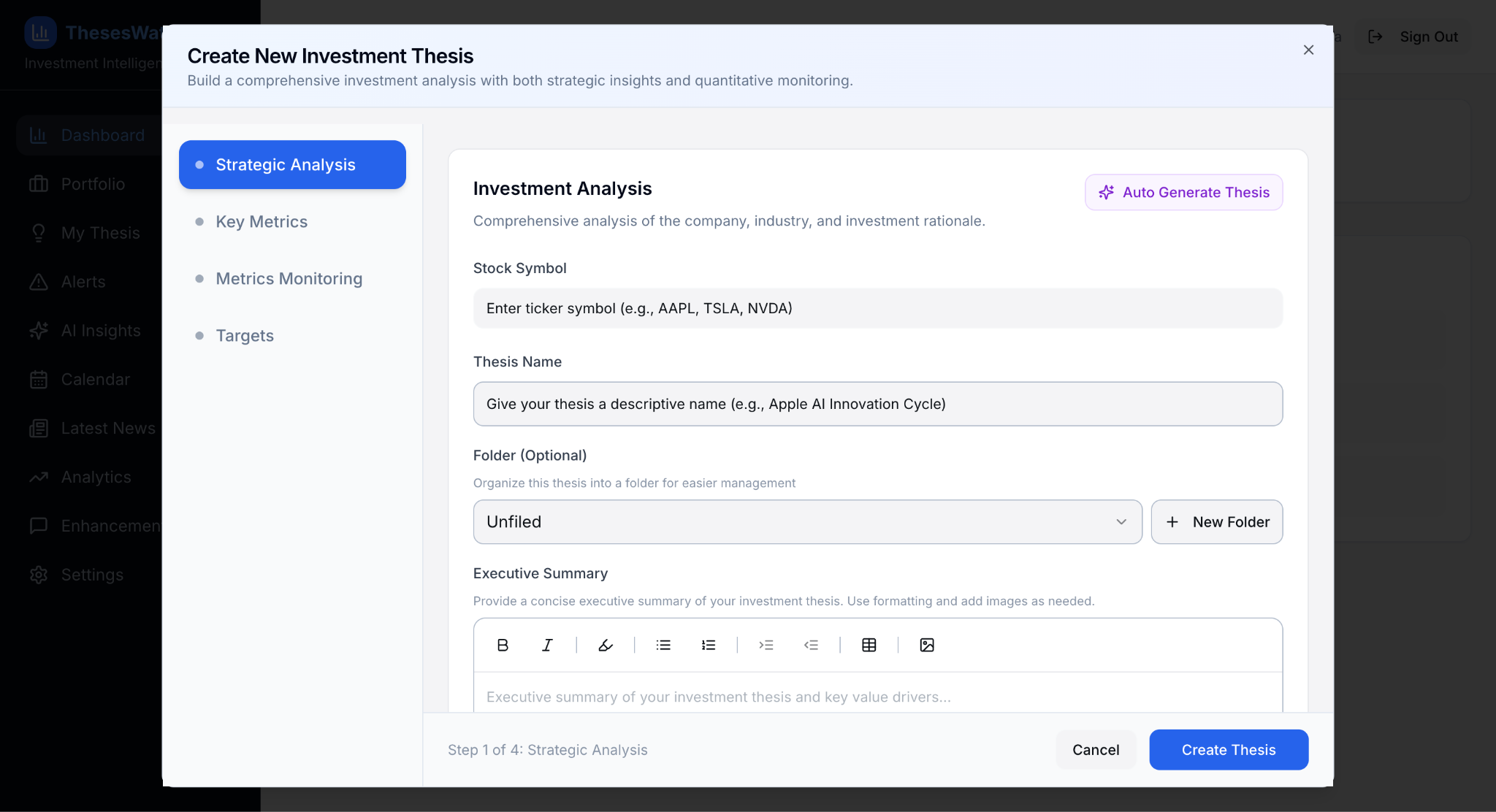
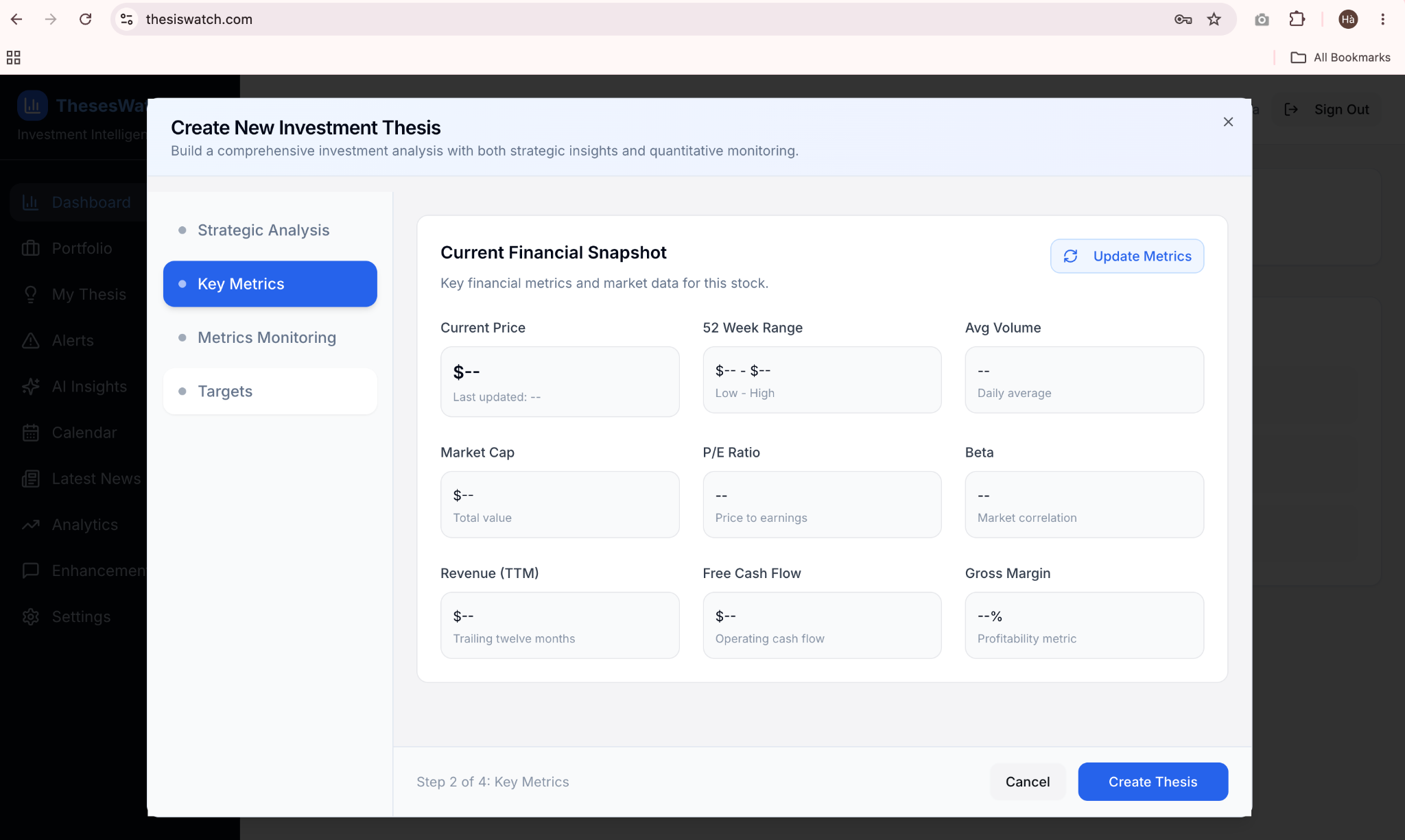
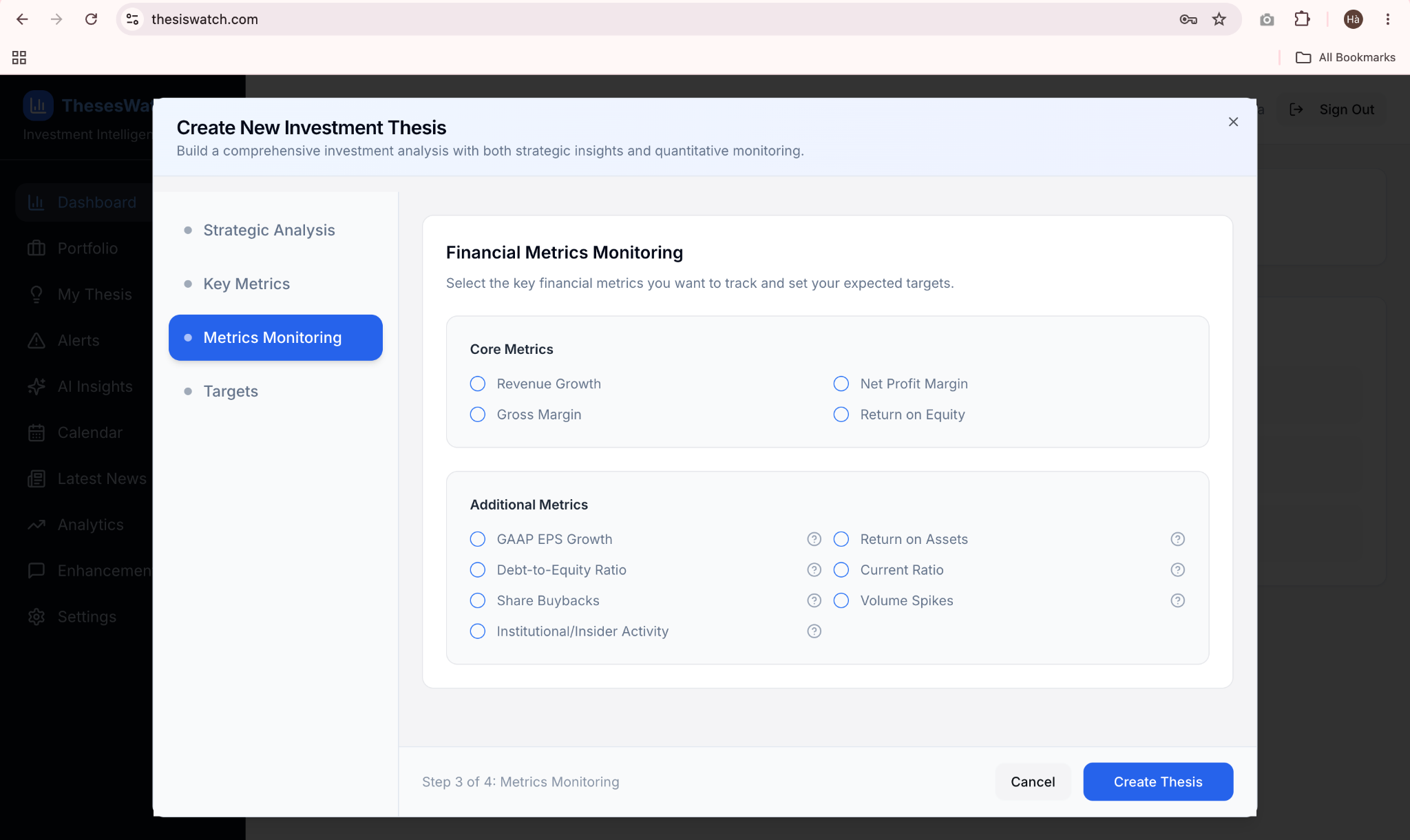
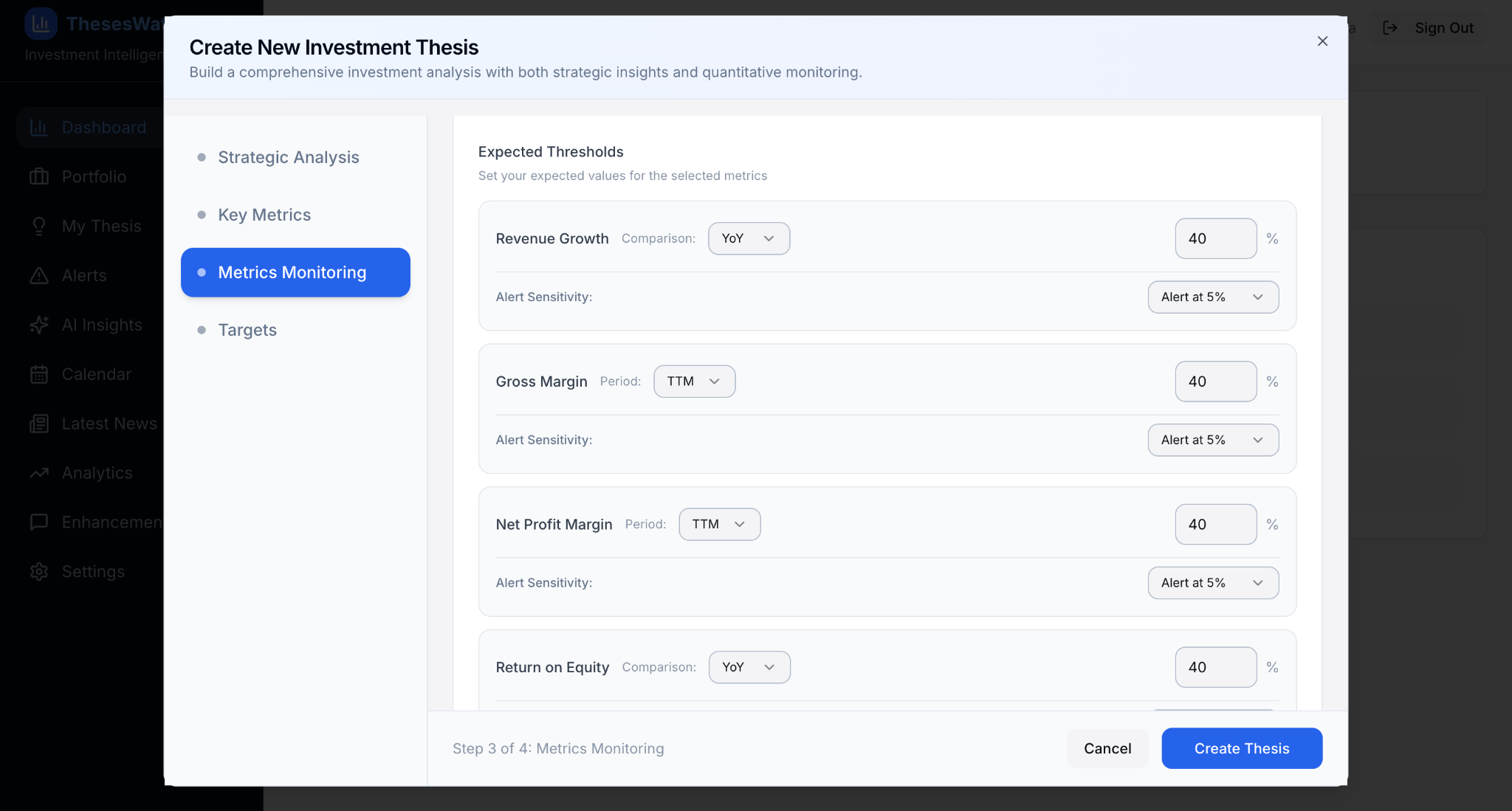
ThesesWatchA thesis published to a public URL and authored by “ThesesWatch AI”. AI-generated research is the distributed artefact, which is a different business from the others here.ThesesWatch“Thesis Invalidation Triggers” as a first-class section, quantified — “profit margin below sector norms (<5%)” — and sitting beside risks and mitigations. Note the numbered citations.ThesesWatchMonitoring is per-signal and toggleable — share buybacks, market sentiment — with an honest empty state that says data appears only after a run.ThesesWatchValuation analysis and an explicit portfolio recommendation close the document.ThesesWatchThe dashboard states its own mechanics in plain text: checks every four hours, Alpha Vantage data, OpenAI for qualitative alerts. The top-level state is On Track / Off Track.ThesesWatchThesis creation is a four-step wizard — and it offers to auto-generate the thesis for you, which sits oddly beside the rigour of step three.ThesesWatchStep two pulls a live financial snapshot into the thesis document.ThesesWatchStep three is where this product separates from every other one here: the investor chooses exactly which metrics constitute the thesis.ThesesWatchAnd then commits to numbers — expected value, comparison basis, and an alert sensitivity per metric. This is the strongest falsification mechanic in the market today.
SYNESI
Conviction journal with drift monitoring
domain not captured in this review
3 / 8stages covered
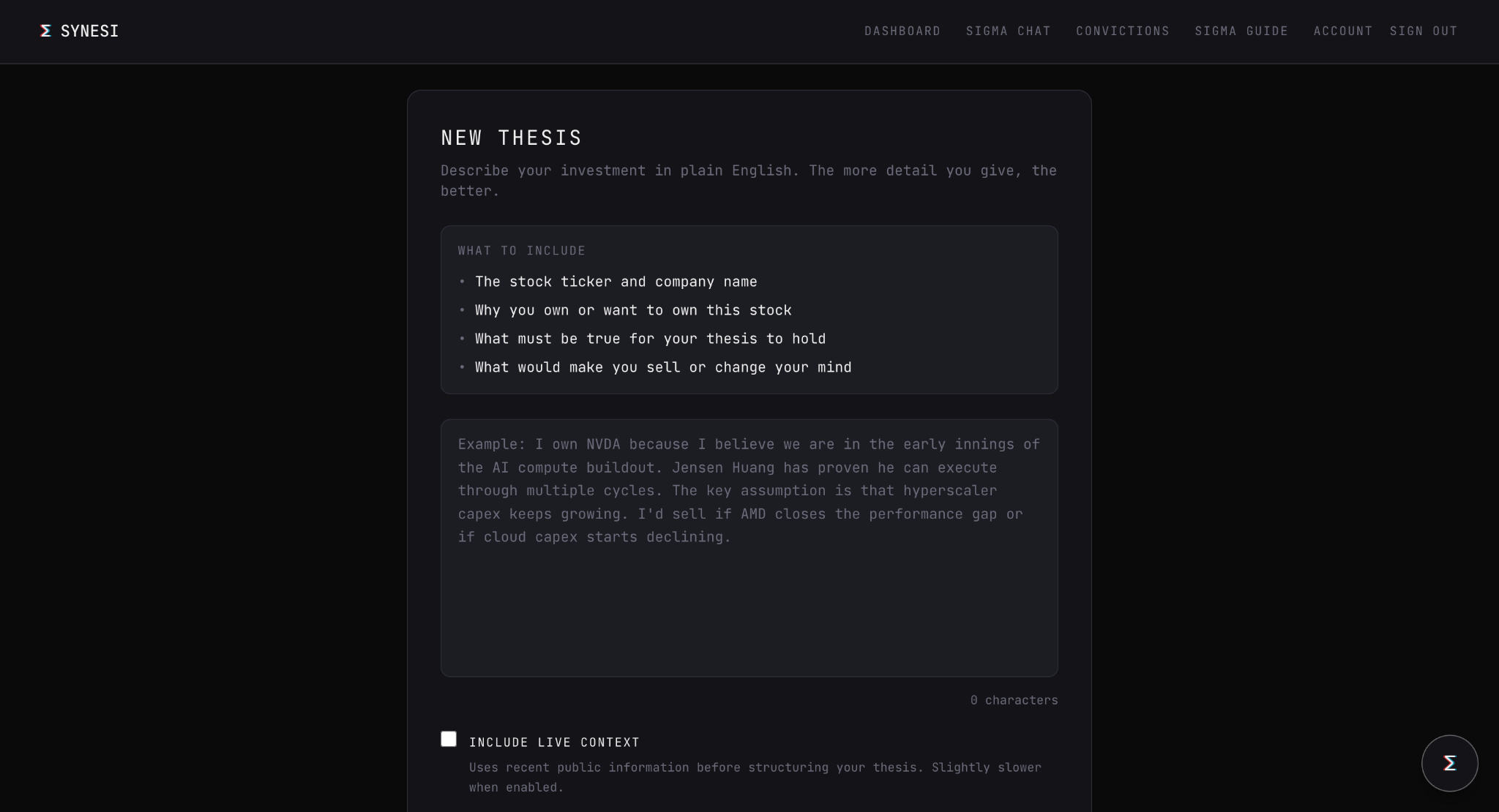
Does wellConviction journal, structured assumptions, exit criteria, AI challenge, bias scanning, thesis-health dashboard and a full audit trail. The composer actively teaches the discipline.
Stops atSource-level provenance. Its bias framing narrows part of our proposed whitespace, so this one is worth watching closely.
We differAnchor the same discipline to authoritative evidence rather than to self-report alone.
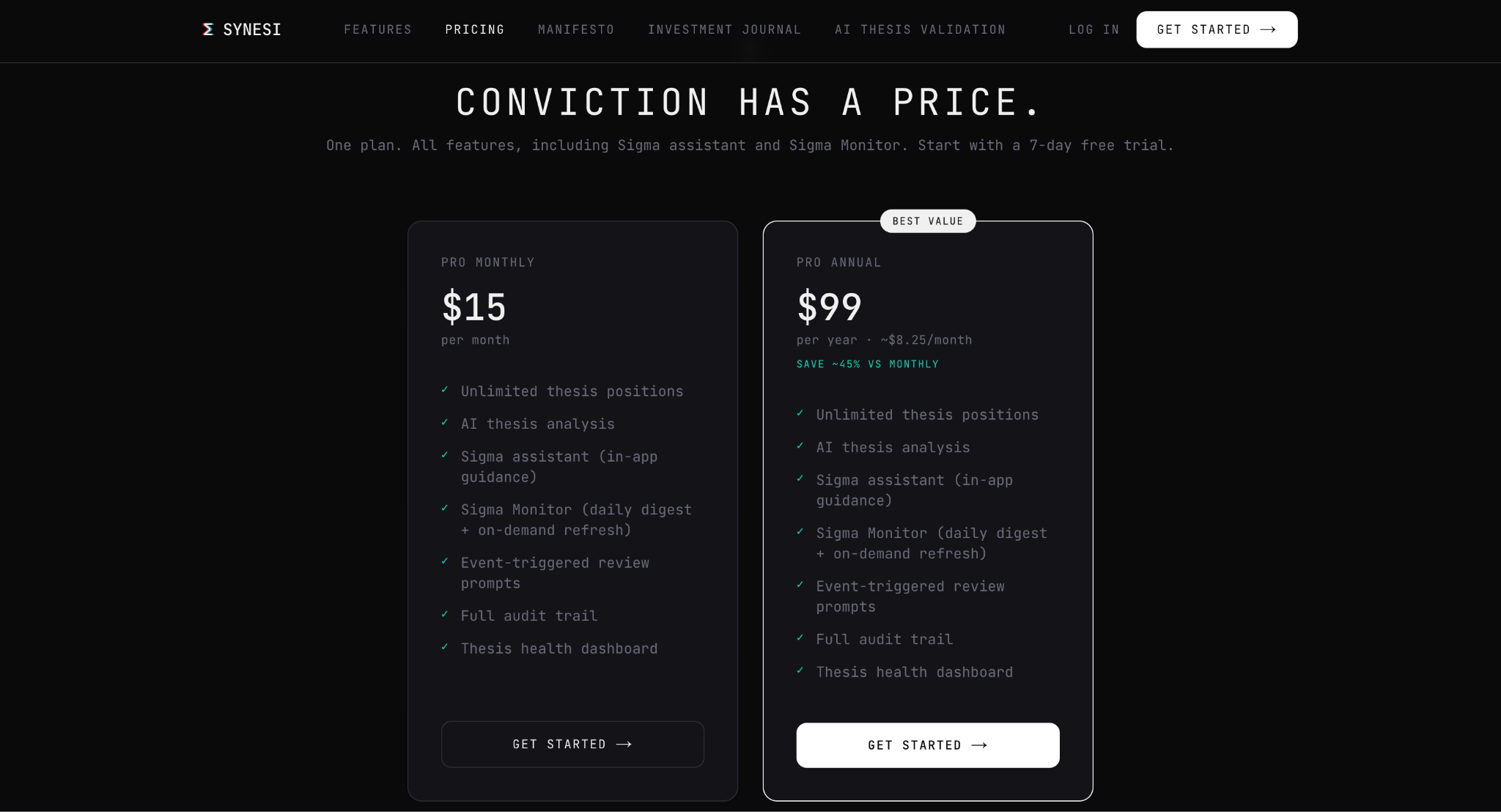
Worth notingPriced openly at $15 per month or $99 per year — the only public price point recovered across all seven products, and a useful anchor for what this category currently sustains.
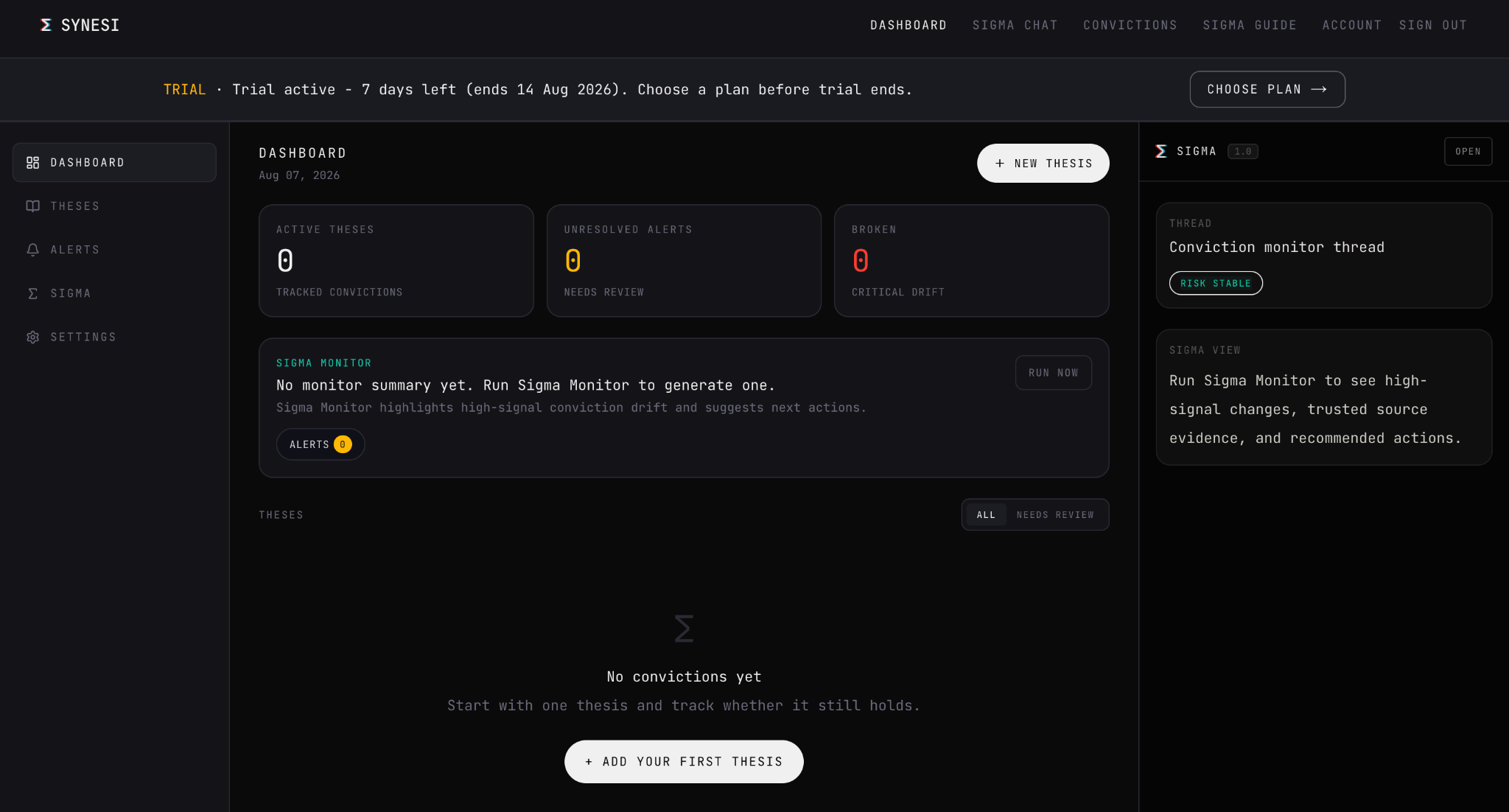
SYNESIThe vocabulary is conviction, not thesis. Three states lead the dashboard — active, unresolved alerts, and BROKEN · critical drift. A persistent assistant rail runs a “conviction monitor thread”.SYNESIOne plan, $15/month or $99/year. The feature list reads as the category roadmap: event-triggered review prompts, full audit trail, thesis health dashboard.SYNESIThe composer teaches the method rather than assuming it — it asks what must be true for the thesis to hold and what would make you sell, and offers to pull live context before structuring.
10 — Where the opening is
The gap is not a missing screen
It is the absence of a dependable link between what an investor knew, what they
believed, what they did, and what happened. Each competitor owns a segment of that chain and
stops.
Authoritative evidence
Exact claim
Investor assumption
Risk / invalidator
Decision
Capital allocated
Monitoring event
Actual outcome
Process review
Investor calibration
Cross-company learning
Highlighted links are those where no reviewed product was publicly
evidenced as reaching them from authoritative company evidence.
The differentiation statement, in one sentence
Other products help an investor research a company, monitor a thesis, or review a decision.
ClassicInvestor shows how evidence changed reasoning, how reasoning changed capital, and how
the outcome changed the investor.